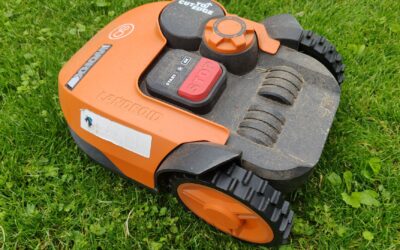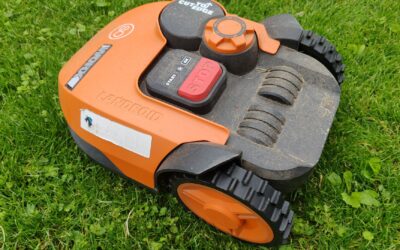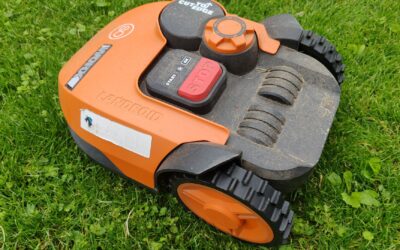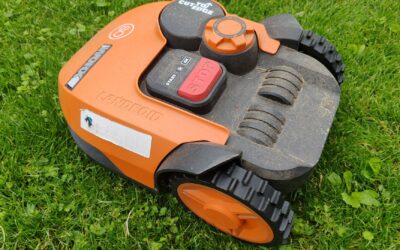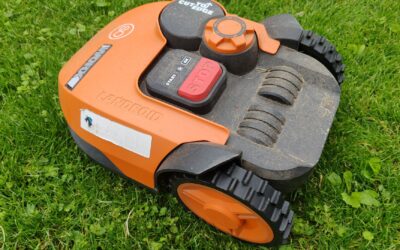
RTK stands for Real-Time Kinematic positioning, and on a robot lawn mower it is a satellite navigation correction system that gives the mower centimeter level accuracy instead of the meter level accuracy of standard GPS. This precision allows the mower to know exactly where it is in your yard at all times, enabling it to follow a planned mowing pattern, avoid obstacles with high reliability, and return to its charging station without wandering. Without RTK, a robot mower relying on standard GPS might drift several feet off course, which is useless for precise lawn care. RTK is the core technology that makes boundary wire free mowing possible and practical.

Pros
- No boundary wires or RTK base station needed, setup is quick and simple
- Excellent traction and stability on steep slopes up to 80%
- Advanced obstacle detection minimizes collisions and damage
- Comprehensive anti-theft features with free 4G tracking
- Precise edge trimming reduces manual rework
Cons
- Heavier than many competitors at 52 pounds, may be difficult to move manually
- Requires cellular 4G coverage for anti-theft and tracking features
- Initial investment is high compared to wired robotic mowers
The MOVA LiDAX Ultra 2000 AWD is a cutting-edge wire-free robotic lawn mower designed for homeowners with medium-sized lawns up to 0.5 acre. It eliminates the hassle of installing boundary wires or RTK base stations by using a 360° 3D LiDAR and AI dual vision system that creates centimeter-accurate maps automatically.
Standout features include all-wheel drive with four 116W hub motors that handle slopes up to 80% and wet grass without getting stuck. The floating cutting discs and advanced suspension system ensure a clean cut on uneven terrain. Obstacle avoidance is top-notch, detecting over 300 objects like toys, pets, and garden furniture.
Build quality is robust, with a 52-pound steel and plastic construction. The dual-disc cutting deck uses 12 blades and a 15.8-inch cutting width, powered by a 36V 243Wh battery that covers 0.25 acre per charge. The Edge-Riding technology leaves only 1.2 inches of uncut grass along boundaries.
Potential drawbacks include the mower's heavy weight, which may make manual handling tedious. The anti-theft system relies on 4G cellular coverage, so remote areas without signal could limit that feature. Additionally, the high price point positions it as a premium investment.
Overall, the MOVA LiDAX Ultra 2000 AWD delivers exceptional performance, convenience, and security for those willing to invest in a top-tier robotic mower. Its wire-free setup, powerful AWD, and intelligent mapping make it a standout choice for complex lawns.
Dimensions: 29 x 21 x 12 inches
Weight: 52 pounds
Battery: 36V 243Wh Li-ion
Cutting Width: 15.8 inches
Cutting Height: 1.2 to 3.9 inches (adjustable)
Blades: 12 razor-sharp blades
Slope Capability: Up to 80%
Obstacle Clearance: 2.4 inches
Navigation: 360° 3D LiDAR + AI dual vision, RTK-free
Connectivity: 4G (3 years free), Wi-Fi
Max Area per Charge: 0.25 acre
Warranty: 3 years
Pros
- No wires or RTK base station required, reduces installation hassle
- Excellent slope handling up to 80% and all-terrain capability
- Advanced obstacle detection with AI learning for safety
- Edge cutting precision leaves only 1.2 inches of uncut grass
- Built-in 4G with 3-year free subscription for anti-theft tracking
Cons
- Battery covers only 0.25 acre per charge; larger lawns require multiple recharge cycles
- No user reviews yet, so real-world reliability is unproven
- Heavy at 52 pounds, making manual handling or relocation difficult
The MOVA LiDAX Ultra 3000 AWD is a top-tier robotic lawn mower designed for homeowners who want a completely wire-free, hands-off mowing experience. With its 360-degree 3D LiDAR and AI dual-vision system, it maps your yard with centimeter precision and avoids over 300 obstacles, including pets and garden furniture. This mower is best suited for medium to large lawns up to 0.75 acre with slopes, uneven terrain, or thick grass, where traditional wire-bound mowers struggle.
Standout features include all-wheel drive with four high-torque motors that handle slopes up to 80% and obstacles up to 2.4 inches without getting stuck. The floating cutting deck adapts to uneven ground, while the UltraTrim 2.0 edge technology leaves only 1.2 inches of uncut grass along borders, reducing manual trimming. The dual-disc system with 12 blades and a 15.8-inch cutting width delivers efficient mowing, and the mower automatically returns to charge, covering the full 0.75 acre over multiple cycles.
Build quality is robust with a 52-pound chassis and advanced suspension for stability on slopes. The included 3-year free 4G connectivity provides real-time GPS tracking and anti-theft protection with PIN locking, a rare and valuable security feature. The smart app allows dual mapping, zone-specific schedules, and cutting height adjustment from 1.2 to 3.9 inches, giving you full control over lawn care.
Potential drawbacks include the high price point, which may be a barrier for some buyers. Also, the battery only supports up to 0.25 acre per charge, so larger properties will require multiple recharge sessions. As a newly launched product with no reviews yet, its long-term reliability is unconfirmed. The heavy weight (52 lbs) can make repositioning or storage cumbersome.
Overall, the MOVA LiDAX Ultra 3000 AWD is an innovative, feature-rich robotic mower that eliminates the hassle of wires and base stations. If you have a complex, sloped lawn and value cutting-edge technology with strong security, this mower is a worthwhile investment despite its premium cost and battery range limitations.

Pros
- No boundary wire installation needed, saving time and effort.
- RTK+Vision navigation provides precise and reliable mowing.
- Advanced obstacle avoidance protects lawn items and pets.
- Fully customizable via app for personalized lawn care.
- Automatic scheduling frees up your weekends.
Cons
- Maximum lawn size of 1/4 acre may not accommodate larger yards.
- The initial setup requires a clear line of sight for RTK base station (typical for RTK systems).
- The product is new with no customer reviews, so long-term reliability is unknown.
The ECOVACS Goat O1000 RTK is a wire-free robot lawn mower designed for homeowners with lawns up to 1/4 acre. It eliminates the need for boundary wires, using RTK and Vision technology for precise navigation and mapping. This makes it an ideal choice for those who want automated lawn care without the installation hassle.
The standout feature is the RTK+Vision+3D ToF navigation system that provides centimeter-level accuracy. Combined with AIVI 3D obstacle avoidance, the mower can detect and avoid furniture, toys, and pets while navigating narrow passages and slopes. In real-world use, this means reliable mowing with minimal intervention.
The Goat O1000 RTK has a compact design at 23.6 x 10.4 x 15.8 inches and weighs 23.6 pounds. It is built with durable materials to withstand outdoor conditions. The TruEdge edge cutting system ensures clean cuts along borders, giving a manicured look to your lawn.
One potential drawback is the lawn size limit of 1/4 acre, which may not be enough for larger properties. Additionally, the price is on the higher end, and the product is new with no customer reviews yet, so long-term reliability is not proven. Battery life information is also not provided, which could be a concern for larger lawns.
Overall, the ECOVACS Goat O1000 RTK is a feature-rich robot mower that offers convenience and precision. It is best suited for small to medium lawns where wire-free installation is a priority. If you are looking for a fully automated mowing solution with advanced navigation, this is a strong contender.
Dimensions: 23.62 x 10.35 x 15.75 inches
Weight: 23.58 pounds
Color: Black
Product Group: Lawn & Patio

Pros
- True 4WD delivers reliable traction on slopes up to 38.7 degrees.
- No boundary wires needed thanks to OmniSense 3.0 with 3D LiDAR and dual AI vision.
- Dual cutting discs with EdgeMaster 2.0 provide fast, even cuts on 0.62-acre lawns.
- Comprehensive anti-theft features including GPS, 4G tracking, and human detection alerts.
- Garage included for convenient storage and protection from the elements.
Cons
- Premium price point may be steep for budget-conscious buyers.
- The 40-pound unit and 25.1 x 10 x 16.9-inch footprint may be bulky for very small or narrow lawn areas.
- Initial setup requires mapping and app configuration, which can be time-consuming for complex yards.
The DREAME A3 AWD Pro 2500 is a premium wire-free robotic lawn mower built for homeowners with challenging, uneven terrain. With true 4WD and dual AI vision, it targets properties up to 0.62 acre where traditional boundary wires are impractical or unsightly.
Its standout capability is conquering slopes up to 38.7 degrees. Independent hub motors give each wheel strong traction, while OmniSense 3.0 combines 3D LiDAR and dual AI vision to map your yard and avoid more than 300 obstacles. The dual floating discs deliver a 15.7-inch cutting width and EdgeMaster 2.0 reduces the need for manual trimming.
The build quality feels robust, as you would expect from a 40-pound machine. The included garage shelters it from weather, and the Dreame app makes it easy to set virtual boundaries, schedule multi-zone mowing, and monitor progress. The 24/7 security suite adds peace of mind with human detection alerts and GPS/4G tracking.
That said, the price point puts this mower firmly in the high-end category. Its size and weight might be too much for very small lawns, and the initial setup requires careful mapping to get the most out of the AI system.
For homeowners with steep, complex yards who want a wire-free mowing solution and are willing to invest in top-tier technology, the DREAME A3 AWD Pro 2500 is an exceptional choice.
Product Dimensions: 25.1 x 10 x 16.9 inches
Weight: 40 pounds
Color: Gray
Cutting Width: 15.7 inches
Max Slope Rating: 38.7 degrees (80%)
Mapping Technology: OmniSense 3.0 with 3D LiDAR and Dual AI Vision
Boundary System: Wire-free, virtual boundaries via app
Drive System: True 4WD with independent hub motors
Security: GPS, 4G tracking, human detection alerts
Included Accessories: Garage Set

Pros
- No perimeter wires required, simplifying installation and yard changes.
- Advanced navigation with RTK + VSLAM for accurate coverage and mapping.
- Vision AI obstacle detection reduces interruptions and protects objects.
- Strong slope handling up to 17 degrees suitable for many residential lawns.
- Edge-cutting design minimizes manual trimming along borders.
Cons
- Limited to 0.3 acre, not suitable for larger properties.
- Vision AI may not work reliably in low light or at night.
- No user reviews yet, so long-term reliability is unproven.
The Sunseeker X3 Plus Robot Lawn Mower is designed for homeowners with small to midsize suburban yards up to 0.3 acre. It combines RTK satellite positioning with VSLAM visual mapping to create a precise yard map, navigate between zones, and mow without the need for buried boundary wires. This makes it an excellent choice for those who want a wire-free setup and easy reconfiguration of mowing areas.
Its standout feature is the AONavi system, which uses a camera and ultrasonic sensors to detect common obstacles like toys, garden furniture, or pets during daylight hours. The mower adjusts its route in real time, reducing the risk of collisions and interruptions. The drive system handles slopes up to 17 degrees and uneven ground, so it can manage typical suburban terrain with gentle inclines.
Build quality is solid with a silver-gray body and an 8-inch floating cutting deck that adjusts from 1.6 to 3.2 inches. The offset blade cuts closer to fences, walkways, and hardscape, significantly reducing manual trimming. At 60 dB, it operates quietly enough not to disturb neighbors. The app allows you to save up to six maps, set schedules, adjust cutting height, and monitor progress, with voice control support for added convenience.
One potential drawback is the limited coverage area of 0.3 acre, which restricts its use to smaller lawns. Additionally, the Vision AI relies on daylight, so it may not perform as well in low-light conditions or at night. As a new product, there are no user reviews yet, so long-term performance and reliability are not fully established.
Overall, the Sunseeker X3 Plus is a compelling wire-free robotic mower for small yards with its advanced navigation, obstacle avoidance, and edge-cutting capabilities. If you have a 0.3 acre property and want a hassle-free mowing experience without perimeter wires, this model is worth considering, especially with the included 2-year warranty and U.S. support.

How RTK Works on a Robot Lawn Mower
RTK uses a fixed base station that receives satellite signals and calculates the errors in those signals caused by atmospheric conditions and satellite orbit drift. The base station then sends a correction signal, often over a radio link or cellular network, to the robot mower. The mower’s own GPS receiver applies this correction in real time, reducing its position error from several meters to about 2 to 3 centimeters.
This correction happens many times per second, so the mower always knows its position within the width of a pencil. For a robot lawn mower, this means it can accurately follow a virtual boundary you set on a map, rather than needing a physical wire buried around the lawn’s edge.
Why RTK Matters for Robot Mower Navigation
Standard GPS is not accurate enough for a robot mower to navigate a lawn reliably. A typical GPS receiver in a smartphone or car has an error of 3 to 5 meters, which means the mower might think it is on the lawn when it is actually in a flower bed, or it might miss a strip of grass entirely. RTK eliminates this uncertainty.
With RTK, a robot mower can be programmed to mow in systematic patterns, such as parallel lines or a grid, covering every inch of grass without overlapping or missing spots. This is far more efficient than the random bump and turn navigation used by older models that rely on boundary wires and collision sensors. The result is a cleaner, more even cut in less time.
RTK Versus Other Navigation Technologies
Before RTK became common, most robot lawn mowers relied on a buried boundary wire to define the mowing area. The mower would detect the wire’s magnetic field and turn around when it got close. This system works but requires installing the wire, which is labor intensive and prone to being cut by garden tools or damaged by frost heave.
Some newer mowers use vision based navigation, where cameras and AI recognize features like grass edges, trees, and flower beds. While this can work well, it struggles in low light, heavy rain, or when the lawn appearance changes dramatically. RTK does not rely on visual cues, so it works consistently in all weather conditions and times of day.
Another alternative is using a combination of GPS and inertial sensors, but without RTK correction, the position drift over time makes this unreliable for precise lawn mowing. RTK is the only consumer grade technology that delivers the accuracy needed for wire free, pattern based mowing.
What You Need for RTK to Work
For RTK to function on a robot lawn mower, you need two key components: a base station and a rover. The base station is usually a separate unit that you place in a fixed location with a clear view of the sky, such as on a rooftop or a pole. It must remain stationary while the mower is operating. The rover is the GPS receiver built into the robot mower itself.
The base station and rover communicate via a radio link or a cellular network. The range of this communication varies by system, but many consumer RTK mowers have a range of several hundred meters, which is more than enough for most residential lawns. You also need a clear view of the sky for both units; tall buildings or dense tree cover can block satellite signals and reduce accuracy.
Common Misconceptions About RTK
A common misconception is that RTK works like a standard GPS tracker you might use in a car or on a phone. It does not. RTK is a correction system, not a standalone positioning system. It requires the base station’s correction data to achieve high accuracy. Without the base station, the mower’s GPS reverts to standard accuracy and becomes unreliable for navigation.
Another misunderstanding is that RTK eliminates the need for any other sensors. While RTK provides excellent position data, most robot mowers still use bump sensors, cliff sensors, and sometimes ultrasonic or radar sensors to detect unexpected obstacles like a child’s toy or a fallen branch that does not appear on the map. RTK is the primary navigation tool, but it is not the only one.
How to Get Started with an RTK Robot Lawn Mower
If you are considering a robot lawn mower that uses RTK, the first step is to evaluate your lawn’s layout and your willingness to set up the base station. You need a location for the base station with a clear view of the sky, and you need to ensure the radio link can reach the mowing area. Most manufacturers provide a mobile app that guides you through the setup, including mapping your lawn’s boundaries on a satellite image.
Once the base station is installed and the map is created, the mower will follow the planned routes automatically. You can adjust the mowing schedule, set no go zones, and monitor progress from the app. The initial setup takes more effort than a boundary wire system, but once it is done, you have a mower that can navigate your entire lawn without any physical boundaries.
- Choose a location for the base station with an unobstructed view of the sky.
- Follow the manufacturer’s app to map your lawn boundaries and no go zones.
- Ensure the radio link between the base station and mower covers your entire lawn.
- Test the mower’s navigation in a small area before letting it run the full lawn.
For a deeper look at how RTK compares to other navigation methods and what to look for in a mower that uses it, see our guide on robot lawn mower navigation technologies. That post covers the pros and cons of each system and helps you decide which one fits your yard.
Frequently Asked Questions
Does RTK work in all weather conditions?
RTK uses satellite signals that can penetrate light rain and clouds, so it works in most weather. Heavy rain or dense fog may reduce signal strength slightly, but the system typically maintains sufficient accuracy for lawn mowing. Snow cover on the base station can block its view of the sky.
Can I use RTK without a base station?
No, RTK requires a base station to generate the correction data. Some systems offer a subscription based network RTK service that uses a network of base stations, but this is less common for residential mowers. Without a base station, the mower uses standard GPS and loses centimeter level accuracy.
Is RTK the same as GPS?
No, RTK is a correction method applied to GPS (or other satellite navigation systems). Standard GPS gives meter level accuracy, while RTK improves that to centimeter level. A robot mower with RTK uses both the raw GPS signal and the correction from the base station to calculate its position.
How far can the RTK base station be from the mower?
The range depends on the radio link used. Many consumer RTK mowers have a range of 300 to 500 meters in open conditions. Walls, trees, and terrain can reduce this range. For most residential lots, this is more than sufficient, but you should verify the manufacturer’s specifications for your property.
Related Guides
Closing
RTK is the technology that gives a robot lawn mower the precision to navigate your yard without a boundary wire, making it a reliable and efficient tool for automated lawn care. If you are ready to explore which RTK mower might work for your lawn, our blog has a detailed guide on the latest models and their features.