Yes, a LiDAR robot mower can work under trees, but how well it performs depends on the density of the canopy, the height of low branches, and the specific navigation system the mower uses. LiDAR (Light Detection and Ranging) uses laser pulses to build a map of the yard, including obstacles and terrain. Under trees, the laser can reflect off trunks, low branches, and even leaves, so the mower can still navigate as long as the overhead cover is not too thick. However, very dense foliage can scatter or block the laser signal, causing the mower to lose its bearings or slow down. Understanding these limitations helps you set realistic expectations for your tree-filled yard.


Pros
- No boundary wires or RTK stations needed, simplifying setup.
- Works in rain, darkness, and under trees, unaffected by weather or lighting.
- Precise 3D LiDAR and AI vision fusion for inch-level positioning and 95% coverage.
- App control with scheduling, mapping, and remote OTA updates.
- Easy maintenance with IPX5 waterproof rating and rinseable chassis.
Cons
- Battery runtime of 2 hours per charge covers only 0.17 acres, requiring multiple charges for full 0.75 acre.
- High price point compared to some wire-based robotic mowers.
- No customer reviews yet, so real-world performance is unverified.
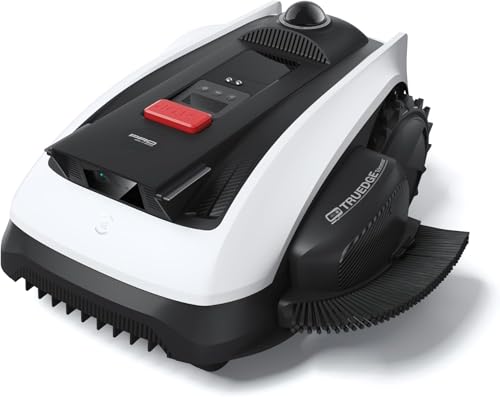
The HOOKII Neomow X SE is a next-generation robotic lawn mower designed for homeowners with mid-sized lawns up to 0.75 acres. It eliminates the need for boundary wires or satellite-based RTK stations, using a combination of 360-degree 3D LiDAR and AI vision to navigate and map your yard. This makes it an excellent choice for those who want a hassle-free, wire-free setup and reliable mowing even in challenging conditions like rain, darkness, or under dense tree cover.
Standout features include its intelligent obstacle avoidance system, which can detect objects as small as 0.4 inches wide and 5.9 inches high, ensuring safety for children, pets, and even small wildlife. The mower achieves inch-level positioning accuracy and covers 95% of the lawn, reducing missed spots. With support for up to 40 customizable zones and no-go areas, you can easily protect flower beds, pools, or play areas via the app. The 3D LiDAR operates without network or satellite signals, making it truly independent.
Design and build quality are robust: the large front-wheel drive all-terrain wheels easily cross 1.6-inch obstacles, and the 11-inch floating deck adapts to uneven terrain while preventing grass clippings buildup. The IPX5 waterproof rating allows simple cleaning with a water jet. The base station can be placed indoors or in a garage to prevent theft, and the mower resumes mowing after recharging thanks to breakpoint resume functionality.
Potential drawbacks include the battery runtime: a single 2-hour charge covers only 0.17 acres, so you may need multiple charging cycles for larger lawns. The price is higher than some wired alternatives, and as a new model, there are no customer reviews yet to confirm long-term reliability. However, the feature set and technology are impressive for the price point.
Verdict: The HOOKII Neomow X SE is a highly capable, wire-free robotic mower that excels in versatility and precision. It is best suited for tech-savvy homeowners who value convenience, smart controls, and the ability to mow in any weather. If you have a 0.5 to 0.75 acre lawn and want a premium, hassle-free mowing experience, this mower is a strong contender.
Color: Gray
Dimensions: 35 x 16 x 22 inches
Weight: 38 pounds
Battery: 13,000 mAh, up to 2 hours runtime
Coverage per charge: 0.17 acres (7,535 sq. ft)
Maximum lawn size: 0.75 acres
Cutting height: 1.18 to 3.35 inches (30 to 85 mm)
Deck width: 11 inches (280 mm)
Obstacle crossing: up to 1.6 inches (4 cm)
Navigation: 360° 3D LiDAR + AI Vision fusion
Connectivity: WiFi, Bluetooth, 4G (1GB free data)
Waterproof rating: IPX5
Product Group: Lawn & Patio

Pros
- Powerful 4WD climbs steep hills up to 80% gradient without slipping
- Advanced LiDAR + AI navigation maintains stable signal near obstacles, no boundary wires needed
- Fast cutting with dual discs and Rush mode covers large areas quickly
- Excellent obstacle handling with suspension and zero-turn capability
- Smart security features include GPS tracking and 24/7 monitoring
Cons
- High upfront cost compared to entry-level robotic mowers
- Requires Wi-Fi and cellular (4G) for full smart features and tracking, which may have ongoing costs
- Maximum lawn size of 0.62 acre may not suit larger properties
The Dreame A3 AWD Pro 2500 is a premium robotic lawn mower designed for homeowners with complex, uneven yards. It uses a combination of 360-degree LiDAR and binocular AI vision to navigate without boundary wires, making setup simple and flexible. This mower is best suited for those who want a hands-off solution on slopes, multi-zone lawns, or properties with many obstacles like trees and flower beds.
Standout features include true four-wheel drive that climbs slopes up to 38.7 degrees and a suspension system that rolls over roots and curbs up to 2.2 inches high. The OmniSense 3.0 navigation system avoids over 300 obstacles in real time, and the dual floating cutting discs provide a 15.8-inch cutting width. With Rush mode it can mow up to 8611 square feet per hour, while EdgeMaster 2.0 trims close to borders for a professional finish.
Build quality is robust with heavy-duty off-road wheels and a weight of 26.4 pounds, giving it stability on wet grass and uneven ground. The design is a medium gray and measures about 39 by 17 by 23 inches. The Dreamehome App allows one-tap height adjustment between 1 and 4 inches, and you can set schedules, create no-go zones, and manage up to 100 zones. Security features like GPS and 4G tracking add peace of mind if the mower is moved.
Potential drawbacks include a high price point and the need for a cellular connection to use tracking and real-time alerts, which might incur extra fees. The 0.62 acre limit may not be enough for larger lawns, and there are no customer reviews yet to confirm real-world durability. Additionally, users who prefer a completely silent mower during operation will appreciate its ultra-quiet performance, but those with tall, dense grass over 8 inches may need to pre-cut.
Overall, the Dreame A3 AWD Pro 2500 is a top-tier choice for tech-savvy homeowners who want a wire-free, reliable mower that handles steep terrain and complex layouts. Its smart navigation and obstacle avoidance are best-in-class, though the investment is significant. If you value convenience and have a smaller, challenging yard, this mower delivers exceptional hands-free lawn care.


Pros
- Exceptional traction on steep slopes and uneven terrain
- Wire-free setup with accurate LiDAR navigation
- Fast recharge time (45 minutes)
- Whisper-quiet operation suitable for any time of day
- Smart features including app control and security camera
Cons
- Higher upfront cost compared to basic robot mowers
- Optional trimmer module sold separately for tighter edges
- Coverage limited to 0.5 acre without additional units
The DREAME A3 AWD is a high-end robotic lawn mower that combines powerful all-wheel drive with advanced LiDAR and AI vision. It is designed for homeowners with challenging lawns featuring steep slopes, complex shapes, and obstacles. Unlike traditional mowers that require buried boundary wires, the A3 AWD maps your yard in minutes using 360-degree LiDAR and binocular AI, ensuring precise navigation even under heavy tree cover.
Standout features include its ability to handle slopes up to 80% and climb over obstacles up to 2.17 inches. This makes it suitable for properties with rolling hills or multi-level terrains. The 45-minute fast charge is a significant advantage, reducing downtime and allowing the mower to complete up to half an acre in a single day. Additionally, the ultra-quiet operation means you can schedule mowing at night without disturbing the peace.
Build quality is robust with a 26.4-pound chassis designed for durability. The included 4G module and HDR camera provide real-time monitoring and theft protection, adding security value. The Dreamehome app offers intuitive control, including custom mowing patterns and animal-friendly modes. However, the optional trimmer module is sold separately, which may be a minor inconvenience for those wanting the smallest possible edge gap.
One potential drawback is the price point, which is higher than many entry-level robot mowers. However, considering the advanced features and the elimination of monthly lawn care bills, it can be a cost-effective long-term investment. Also, the coverage area is rated up to 0.5 acre, so larger properties may need additional units.
Overall, the DREAME A3 AWD is an excellent choice for tech-savvy homeowners who prioritize a wire-free, high-performance mowing solution. It delivers professional-grade results with minimal effort, making weekends truly free for relaxation. If you have a challenging lawn and want top-tier technology, this mower is worth the investment.

How LiDAR Works Under Tree Canopies
LiDAR sensors emit rapid laser pulses that bounce off surfaces and return to the sensor, allowing the mower to calculate distances and create a 3D map of its surroundings. Under trees, the laser can detect trunks, branches, and even the ground if the canopy is sparse. The mower uses this map to avoid collisions and stay within its boundary.
When the canopy is dense, the laser may hit leaves and branches before reaching the ground, creating a noisy and incomplete map. Some mowers are designed to filter out this noise, but others may struggle, especially if the tree cover is thick year-round. The height of the sensor also matters: a low-mounted LiDAR unit sees more of the trunk and less of the canopy, which can improve performance under low-hanging branches.
Common Challenges: Leaves, Low Branches, and GPS Interference
Falling leaves can confuse a LiDAR mower because they appear as moving obstacles on the ground. The mower may treat them as objects to avoid, causing it to stop or change direction frequently. This is usually a temporary issue during autumn, but it can affect mowing efficiency.
Low-hanging branches are another problem. If a branch extends below the LiDAR sensor’s height, it may not be detected as an obstacle, and the mower could collide with it. This can damage the mower or the branch. Many modern mowers have a top-mounted LiDAR that scans above the mower’s height, so they can detect branches that hang low enough to hit the sensor.
If your mower uses a hybrid system that combines LiDAR with RTK GPS, the tree canopy can also block the GPS signal from satellites. This causes the mower to rely solely on LiDAR, which may reduce accuracy in some cases. The more trees you have, the more important it is to have a robust LiDAR-only navigation mode.
Tree Type and Seasonal Effects
Deciduous trees that lose their leaves in winter allow more light (and LiDAR pulses) to reach the ground, so mowers often perform better under them during the cold months. Evergreen trees, which retain dense needles year-round, present a constant challenge, especially if they are low-branching. The LiDAR signal can struggle to penetrate the thick foliage, leading to more frequent disorientation or mapping errors.
The season also affects ground moisture and leaf litter. Wet leaves can reflect LiDAR differently, while dry leaves may be blown by wind, creating false obstacles. These factors compound the challenge, but many mowers have software updates that improve performance over time.
LiDAR-Only vs. Hybrid Systems Under Trees
Some robot mowers rely solely on LiDAR for navigation, while others use a combination of LiDAR and RTK GPS. Under trees, a LiDAR-only system can be more reliable because it does not depend on satellite signals. The mower builds its map from the ground up, using the laser to detect every trunk and branch it encounters.
Hybrid systems, however, can lose GPS lock under dense canopy, forcing the mower to switch to LiDAR-only mode. If the LiDAR sensor is not advanced enough, the mower may need to stop and reacquire the signal, slowing down the mowing process. For heavily wooded yards, a pure LiDAR mower may be the better choice, but even then, you need to manage the environment.
What You Can Do to Improve LiDAR Performance Under Trees
- Trim low-hanging branches so they are at least 2 feet above the mower’s highest point. This prevents collisions and gives the LiDAR a clear view of the trunk.
- Rake or blow away heavy leaf piles before the mower runs. A thick layer of leaves can be misinterpreted as solid ground.
- If your mower uses RTK, ensure the GPS base station is placed in an open area away from trees to improve signal reliability.
- Run the mower during dry weather when leaves are less likely to be wet and heavy.
- Consider a mower with a top-mounted LiDAR sensor that has a higher field of view, which can detect overhead obstacles.
These steps reduce the chance of the mower getting stuck or losing its map. For a deeper look at how precision navigation works in different conditions, see our guide on how accurate RTK robot mowers are and what affects precision. That article explains the differences between LiDAR and RTK in more detail.
Frequently Asked Questions
Can a LiDAR robot mower navigate under a dense tree canopy?
It can, but performance may drop. Very dense evergreen canopies can scatter the LiDAR pulses, causing the mower to lose its orientation or map inaccurately. Sparse canopies are usually fine.
Do leaves on the ground affect LiDAR navigation?
Yes, dry leaves can be detected as obstacles, especially if they are piled up. The mower may treat them as solid objects and avoid them, which can leave unmown patches. Wet leaves reflect LiDAR differently but are less likely to be mistaken for obstacles.
Will my robot mower get stuck under low-hanging branches?
It can if the branch is low enough to hit the mower’s top. Most LiDAR mowers have sensors that detect overhead obstacles, but if the branch is below the sensor’s range, it may not be detected. Trim branches to avoid issues.
Is RTK better than LiDAR for yards with many trees?
Generally, no. RTK relies on GPS, which can be blocked by tree cover. LiDAR is more reliable under trees because it works independently of satellite signals. Hybrid systems can switch to LiDAR, but pure LiDAR is often better for wooded yards.
Does the time of day affect LiDAR under trees?
LiDAR is not affected by sunlight like cameras are, so it works equally well day or night. However, shadows from trees can create areas of high contrast on the ground, which may confuse some mowers’ obstacle detection algorithms.
Related Guides
- Does LiDAR Robot Mower Work at Night?
- What Is LiDAR Robot Lawn Mower?
- Best Large Universal Robot Mower Garage in
- Best Adjustable Robot Mower Garages for 2026
Final Thoughts
LiDAR robot mowers can work under trees, but you need to manage the environment and choose a system suited to your yard’s canopy density. By trimming low branches and clearing leaves, you can help the mower perform at its best. For more on setting up a wire-free mower in a complex yard, check out our guide on how to map a wire free robot mower.