Yes, a LiDAR robot mower works at night. LiDAR uses laser pulses to map the environment, so it does not depend on visible light to navigate. This makes it one of the most reliable navigation technologies for nighttime mowing, unlike camera-based systems that require good lighting. However, while the navigation works, you should still consider factors like grass moisture and battery capacity before scheduling night runs.


Pros
- No boundary wires or RTK stations needed, simplifying setup.
- Works in rain, darkness, and under trees, unaffected by weather or lighting.
- Precise 3D LiDAR and AI vision fusion for inch-level positioning and 95% coverage.
- App control with scheduling, mapping, and remote OTA updates.
- Easy maintenance with IPX5 waterproof rating and rinseable chassis.
Cons
- Battery runtime of 2 hours per charge covers only 0.17 acres, requiring multiple charges for full 0.75 acre.
- High price point compared to some wire-based robotic mowers.
- No customer reviews yet, so real-world performance is unverified.
The HOOKII Neomow X SE is a next-generation robotic lawn mower designed for homeowners with mid-sized lawns up to 0.75 acres. It eliminates the need for boundary wires or satellite-based RTK stations, using a combination of 360-degree 3D LiDAR and AI vision to navigate and map your yard. This makes it an excellent choice for those who want a hassle-free, wire-free setup and reliable mowing even in challenging conditions like rain, darkness, or under dense tree cover.
Standout features include its intelligent obstacle avoidance system, which can detect objects as small as 0.4 inches wide and 5.9 inches high, ensuring safety for children, pets, and even small wildlife. The mower achieves inch-level positioning accuracy and covers 95% of the lawn, reducing missed spots. With support for up to 40 customizable zones and no-go areas, you can easily protect flower beds, pools, or play areas via the app. The 3D LiDAR operates without network or satellite signals, making it truly independent.
Design and build quality are robust: the large front-wheel drive all-terrain wheels easily cross 1.6-inch obstacles, and the 11-inch floating deck adapts to uneven terrain while preventing grass clippings buildup. The IPX5 waterproof rating allows simple cleaning with a water jet. The base station can be placed indoors or in a garage to prevent theft, and the mower resumes mowing after recharging thanks to breakpoint resume functionality.
Potential drawbacks include the battery runtime: a single 2-hour charge covers only 0.17 acres, so you may need multiple charging cycles for larger lawns. The price is higher than some wired alternatives, and as a new model, there are no customer reviews yet to confirm long-term reliability. However, the feature set and technology are impressive for the price point.
Verdict: The HOOKII Neomow X SE is a highly capable, wire-free robotic mower that excels in versatility and precision. It is best suited for tech-savvy homeowners who value convenience, smart controls, and the ability to mow in any weather. If you have a 0.5 to 0.75 acre lawn and want a premium, hassle-free mowing experience, this mower is a strong contender.
Color: Gray
Dimensions: 35 x 16 x 22 inches
Weight: 38 pounds
Battery: 13,000 mAh, up to 2 hours runtime
Coverage per charge: 0.17 acres (7,535 sq. ft)
Maximum lawn size: 0.75 acres
Cutting height: 1.18 to 3.35 inches (30 to 85 mm)
Deck width: 11 inches (280 mm)
Obstacle crossing: up to 1.6 inches (4 cm)
Navigation: 360° 3D LiDAR + AI Vision fusion
Connectivity: WiFi, Bluetooth, 4G (1GB free data)
Waterproof rating: IPX5
Product Group: Lawn & Patio


Pros
- Exceptional traction on steep slopes and uneven terrain
- Wire-free setup with accurate LiDAR navigation
- Fast recharge time (45 minutes)
- Whisper-quiet operation suitable for any time of day
- Smart features including app control and security camera
Cons
- Higher upfront cost compared to basic robot mowers
- Optional trimmer module sold separately for tighter edges
- Coverage limited to 0.5 acre without additional units
The DREAME A3 AWD is a high-end robotic lawn mower that combines powerful all-wheel drive with advanced LiDAR and AI vision. It is designed for homeowners with challenging lawns featuring steep slopes, complex shapes, and obstacles. Unlike traditional mowers that require buried boundary wires, the A3 AWD maps your yard in minutes using 360-degree LiDAR and binocular AI, ensuring precise navigation even under heavy tree cover.
Standout features include its ability to handle slopes up to 80% and climb over obstacles up to 2.17 inches. This makes it suitable for properties with rolling hills or multi-level terrains. The 45-minute fast charge is a significant advantage, reducing downtime and allowing the mower to complete up to half an acre in a single day. Additionally, the ultra-quiet operation means you can schedule mowing at night without disturbing the peace.
Build quality is robust with a 26.4-pound chassis designed for durability. The included 4G module and HDR camera provide real-time monitoring and theft protection, adding security value. The Dreamehome app offers intuitive control, including custom mowing patterns and animal-friendly modes. However, the optional trimmer module is sold separately, which may be a minor inconvenience for those wanting the smallest possible edge gap.
One potential drawback is the price point, which is higher than many entry-level robot mowers. However, considering the advanced features and the elimination of monthly lawn care bills, it can be a cost-effective long-term investment. Also, the coverage area is rated up to 0.5 acre, so larger properties may need additional units.
Overall, the DREAME A3 AWD is an excellent choice for tech-savvy homeowners who prioritize a wire-free, high-performance mowing solution. It delivers professional-grade results with minimal effort, making weekends truly free for relaxation. If you have a challenging lawn and want top-tier technology, this mower is worth the investment.
Pros
- True wire-free operation with no perimeter wire or base-station calibration
- Advanced obstacle and terrain response for complex, uneven yards
- Works in various lighting conditions including low light and nighttime
- Easy app mapping with multiple maps and zone management
- Quiet and precise cutting with floating deck and edge mode
Cons
- Price point is higher than some traditional wire-based robot mowers
- Limited to 0.25 acres, not suitable for larger lawns without additional units
- Zero reviews at launch may leave some early adopters cautious about performance reliability
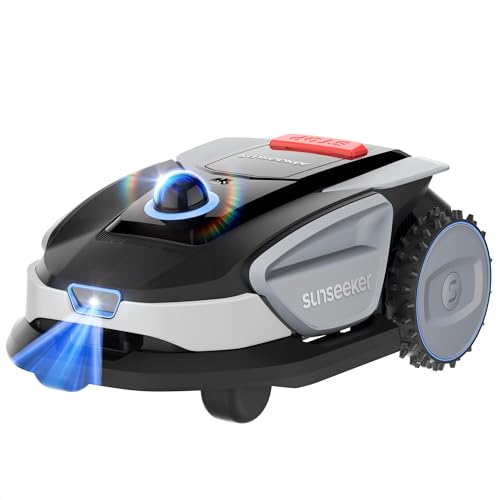
The Sunseeker S4 Robot Lawn Mower brings advanced navigation to small and complex yards. Designed for up to 0.25 acre, it uses 3D LiDAR and Vision AI to map and mow without any perimeter wire. This makes it perfect for homeowners with dense trees, narrow passages, multiple zones, uneven ground, or areas with weak GPS signals. If you have a challenging lawn and want a hands-free solution, the S4 is built specifically for you.
Standout features include the 360 degree AllSense system with 10 TOPS of processing power. It creates a 3D map and plans systematic parallel routes even in low light or at night. The mower identifies common obstacles like toys, garden tools, and pets, then adjusts its path accordingly. Rear-wheel drive helps it handle bumps, ruts, and slopes up to 22 degrees. In real-world use, this means reliable cutting without getting stuck, even in tricky spots.
The wire-free app mapping is a game changer. You simply drive the S4 around your yard using the app to create a map. You can save up to five maps, set up to 100 zones or no-go areas, and choose cutting patterns and schedules. If interrupted, it resumes where it left off. The cutting system uses six blades with a 7-inch width and adjustable height from 1.6 to 3.2 inches. The floating cut adapts to turf, and ride-on-edge mode cleans borders neatly.
Build quality feels solid with a durable silver-black design. It weighs 25 pounds and measures 25 by 16.5 by 11 inches. Operation is quiet at only 60 dB, so you can mow any time without disturbing neighbors. A rain sensor automatically returns the mower to its charging station. Voice control support and a responsive U.S. customer service team with a 2-year warranty add peace of mind. The only potential drawbacks are the price and the fact that it targets smaller lawns only.
Overall, the Sunseeker S4 is a top-tier choice for anyone with a complex, wire-free yard up to 0.25 acre. Its advanced LiDAR and AI navigation set it apart from many competitors. While the lack of initial reviews may give some pause, the feature set and support make it a compelling option for hassle-free lawn care. For precise, quiet, and intelligent mowing without wires, the S4 is highly recommended.
Brand: SUNSEEKER
Model: Sunseeker S4
Color: Silver Black
Dimensions: 25 x 16.5 x 11 inches
Weight: 25 pounds
Coverage Area: 0.25 acre (10,890 sq. ft.)
Navigation: 360 3D LiDAR + Vision AI (10 TOPS AllSense)
Mapping: Wire-free app mapping, save 5 maps, up to 100 zones
Cutting Width: 7 inches
Cutting Height: 1.6 - 3.2 inches
Blades: Six blades
Slope Capability: Up to 22° / 42%
Minimum Passage: 31.5 inches
Noise Level: 60 dB
Rain Sensor: Yes
Voice Control: Yes (compatible with Alexa/Google)
Warranty: 2-year, U.S. local support
How LiDAR Navigation Works at Night
LiDAR stands for Light Detection and Ranging. The mower emits rapid laser beams and measures the time it takes for them to bounce back. This creates a real-time 3D map of obstacles, slopes, and boundaries. Since the laser is active (it sends its own light), it works equally well in total darkness or bright sunlight. The sensor does not rely on ambient light the way a camera does.
Because of this, your LiDAR mower can precisely avoid trees, flower beds, and garden furniture even when it is pitch black outside. The internal map built during the initial setup remains accurate regardless of the time of day. Some models even include headlights for visibility, but those are for convenience, not for navigation.
LiDAR vs Camera-Based Mowers at Night
Camera-based mowers use visual data to identify landmarks and obstacles. They struggle in low light or complete darkness because the camera must “see” the environment. LiDAR, on the other hand, measures distances directly and does not need a picture. That makes LiDAR mowers a better choice if you plan to mow after sunset or before dawn.
Some hybrid models combine LiDAR with cameras for extra redundancy, but the core LiDAR system alone is sufficient for night operation. If you are considering a wire free mower that you can schedule at any hour, LiDAR based models are the most reliable for nighttime use.
Potential Limitations of Night Mowing with LiDAR
While LiDAR navigation works in the dark, night mowing itself has practical limitations. Grass is often wet with dew at night, which can cause clumping and reduce cutting quality. Wet grass also increases the load on the mower’s battery, potentially shortening your run time. If your yard has heavy dew, morning or midday might give better results even if the navigation is fine.
Another factor is noise. If you have close neighbors, mowing at night might disturb them. Also, you won’t see the mower if something goes wrong, so a good initial map and clear obstacles are extra important. At night, your mower relies entirely on its pre built map, so any changes in the yard (like new furniture or fallen branches) can cause issues.
Is Night Mowing a Good Idea for Your Yard?
If you regularly mow at night, choose a mower with LiDAR and ensure you have a complete, updated map of your lawn. Avoid mowing when the grass is wet from dew or rain, as that can affect both cut quality and battery life. For large or complex yards, consider an RTK mower if satellite coverage is good, but LiDAR remains the most reliable in any light condition.
Before your first night run, walk the yard to pick up any obstacles that might not be on the current map. Most LiDAR mowers allow you to update the map via an app, so you can add new no go zones or remove old ones. This proactive step will prevent unexpected collisions in the dark.
How to Get the Best Night Mowing Performance
- Make sure your LiDAR mower has a fully trained map of the yard before scheduling night sessions. An incomplete map leads to errors in the dark.
- Check the weather forecast. Avoid mowing on nights with heavy dew or rain to prevent cutting issues and battery drain.
- Remove any new obstacles like garden tools or toys from the lawn before the mower starts.
- If your mower has headlights, enable them so you can see the mower if you need to check on it.
For a detailed walkthrough on creating an accurate map for your wire free mower, check out our guide on how to map a wire free robot mower. A solid map is the foundation for reliable nighttime operation, especially with LiDAR navigation.
Related Guides
- What Is LiDAR Robot Lawn Mower?
- How Does LiDAR Robot Lawn Mower Work
- Best Universal Robot Mower Garage for
Frequently Asked Questions
Can LiDAR robot mowers see in complete darkness?
Yes, LiDAR mowers do not need any light to navigate. They emit their own laser beams and measure reflections, so they work perfectly in pitch black conditions. The technology is active, not passive like a camera.
Will my LiDAR mower bump into objects at night?
It can bump into new objects that weren’t on its map, such as a chair you left out or a fallen branch. However, the LiDAR sensor detects most obstacles in real time and will avoid them as long as they are within its detection range. Keeping the map updated reduces the risk.
Do I need extra lighting for a LiDAR mower to work at night?
No, extra lighting is not required for navigation. Some mowers include headlights so you can see them in the dark, but those are for your convenience. The LiDAR system itself functions without any supplemental light.
Is it safe to mow at night with a LiDAR robot mower?
Yes, it is safe for the mower and the yard. The main risks are wet grass and obstacles you didn’t see. As long as you maintain a current map and avoid wet conditions, night mowing is just as safe as daytime mowing.
If you want to compare LiDAR with other navigation technologies like RTK, read our article on how accurate RTK robot mowers are to see which system best fits your nighttime mowing needs.
LiDAR robot mowers work at night because they use active laser scanning, not visible light. For the most reliable night operation, ensure your mower has a fully trained map and that you avoid wet grass. Check out our guide on how to map a wire free robot mower to get started with accurate mapping.