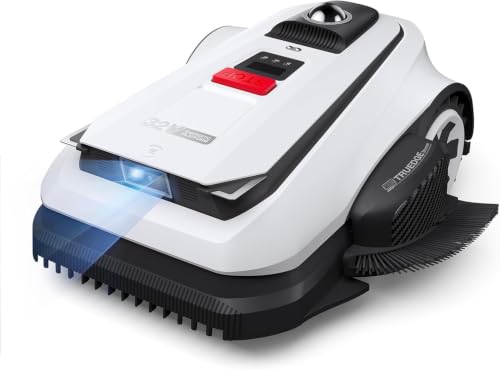
LiDAR robot mowers are generally very accurate, often positioning themselves within an inch or two of their intended path, but that precision depends on a few key conditions. The laser-based system builds a detailed map of your yard and tracks the mower’s location in real time, which allows for consistent cutting patterns. However, accuracy can vary with obstacles, lighting, and how well the initial mapping was performed.

Pros
- No boundary wires or RTK stations needed, simplifying setup.
- Works in rain, darkness, and under trees, unaffected by weather or lighting.
- Precise 3D LiDAR and AI vision fusion for inch-level positioning and 95% coverage.
- App control with scheduling, mapping, and remote OTA updates.
- Easy maintenance with IPX5 waterproof rating and rinseable chassis.
Cons
- Battery runtime of 2 hours per charge covers only 0.17 acres, requiring multiple charges for full 0.75 acre.
- High price point compared to some wire-based robotic mowers.
- No customer reviews yet, so real-world performance is unverified.
The HOOKII Neomow X SE is a next-generation robotic lawn mower designed for homeowners with mid-sized lawns up to 0.75 acres. It eliminates the need for boundary wires or satellite-based RTK stations, using a combination of 360-degree 3D LiDAR and AI vision to navigate and map your yard. This makes it an excellent choice for those who want a hassle-free, wire-free setup and reliable mowing even in challenging conditions like rain, darkness, or under dense tree cover.
Standout features include its intelligent obstacle avoidance system, which can detect objects as small as 0.4 inches wide and 5.9 inches high, ensuring safety for children, pets, and even small wildlife. The mower achieves inch-level positioning accuracy and covers 95% of the lawn, reducing missed spots. With support for up to 40 customizable zones and no-go areas, you can easily protect flower beds, pools, or play areas via the app. The 3D LiDAR operates without network or satellite signals, making it truly independent.
Design and build quality are robust: the large front-wheel drive all-terrain wheels easily cross 1.6-inch obstacles, and the 11-inch floating deck adapts to uneven terrain while preventing grass clippings buildup. The IPX5 waterproof rating allows simple cleaning with a water jet. The base station can be placed indoors or in a garage to prevent theft, and the mower resumes mowing after recharging thanks to breakpoint resume functionality.
Potential drawbacks include the battery runtime: a single 2-hour charge covers only 0.17 acres, so you may need multiple charging cycles for larger lawns. The price is higher than some wired alternatives, and as a new model, there are no customer reviews yet to confirm long-term reliability. However, the feature set and technology are impressive for the price point.
Verdict: The HOOKII Neomow X SE is a highly capable, wire-free robotic mower that excels in versatility and precision. It is best suited for tech-savvy homeowners who value convenience, smart controls, and the ability to mow in any weather. If you have a 0.5 to 0.75 acre lawn and want a premium, hassle-free mowing experience, this mower is a strong contender.
Color: Gray
Dimensions: 35 x 16 x 22 inches
Weight: 38 pounds
Battery: 13,000 mAh, up to 2 hours runtime
Coverage per charge: 0.17 acres (7,535 sq. ft)
Maximum lawn size: 0.75 acres
Cutting height: 1.18 to 3.35 inches (30 to 85 mm)
Deck width: 11 inches (280 mm)
Obstacle crossing: up to 1.6 inches (4 cm)
Navigation: 360° 3D LiDAR + AI Vision fusion
Connectivity: WiFi, Bluetooth, 4G (1GB free data)
Waterproof rating: IPX5
Product Group: Lawn & Patio


Pros
- Completely wire-free installation eliminates tedious perimeter wire burying.
- Powerful AWD and active steering handle steep slopes and tough terrain effortlessly.
- Advanced LiDAR and AI obstacle avoidance ensure safe, collision-free operation.
- Wide cutting deck reduces mowing time and edges precisely without manual trimming.
- Includes 3-year 4G connectivity and comprehensive anti-theft features for security.
Cons
- High price point may be a barrier for budget-conscious buyers.
- Limited to 0.49 acre, not suitable for larger lawns.
- No user reviews yet, so real-world performance is unverified.
The roborock RockMow X120H is a next-generation robotic lawn mower designed for homeowners who want a truly hands-off mowing experience. With no perimeter wires or RTK base station required, it offers effortless setup and advanced navigation for lawns up to 0.49 acre. This mower is ideal for tech-savvy users who value precision, safety, and convenience in their lawn care routine.
Standout features include a 360-degree 3D LiDAR system paired with dual-camera AI vision for real-time obstacle avoidance. It creates a centimeter-accurate map of your yard in minutes and navigates around toys, furniture, pets, and people without getting stuck. The all-wheel drive and active steering system handle slopes up to 80 percent and obstacles up to 3.15 inches, while the dynamic suspension keeps the cutting deck stable on uneven ground for a flawless cut.
Design and build quality are premium, with a rugged dark grey chassis and IPX6 waterproofing. The 9.49-inch cutting width and adjustable height from 1.57 to 3.54 inches accommodate various grass types and deliver precise edge mowing, reducing the need for manual trimming. The included 3-year 4G connectivity and PIN/GPS anti-theft system provide added security and remote control via the Roborock app.
Potential drawbacks include a high price point and a maximum coverage of 0.49 acre, which may not suit larger properties. Additionally, as a new release, there are no user reviews yet to validate long-term reliability. However, the technology and build quality are impressive for a wire-free mower.
Overall, the roborock RockMow X120H is a top-tier choice for homeowners seeking a premium, wire-free robotic lawn mower with advanced mapping, obstacle avoidance, and slope handling. If you value convenience and have a medium-sized lawn, this mower delivers exceptional performance and peace of mind.
Color: Dark Grey
Dimensions: 25 x 11 x 18 inches
Weight: 50 pounds
Cutting Width: 9.49 inches
Cutting Height Range: 1.57 to 3.54 inches
Max Slope: 80% (38.7 degrees)
Max Obstacle: 3.15 inches
Connectivity: 4G cellular (3 years included), Wi-Fi, Bluetooth
Waterproof Rating: IPX6
Anti-theft: PIN and GPS tracking

Pros
- Truly wire-free installation saves time and hassle compared to traditional robotic mowers.
- Dual-LiDAR provides reliable navigation in shaded or obstructed areas where GPS fails.
- Edge trimming capability reduces the need for manual edging along walkways and gardens.
- Effective obstacle avoidance protects pets, toys, and garden decorations during operation.
- Compact size allows it to access narrow pathways and complex lawn layouts with ease.
Cons
- Higher upfront cost compared to some wire-based robotic mowers on the market.
- Requires a flat, well-defined lawn area for optimal performance on slopes or uneven terrain.
- Battery life and coverage may vary in very hot or cold weather conditions.
The ECOVACS Goat O1000 LiDAR PRO is a wire-free robotic lawn mower designed for homeowners who want a smarter, easier way to maintain their lawn without the hassle of installing perimeter wires. It is particularly suited for lawns up to 1/4 acre with complex layouts, narrow pathways, or challenging obstacles like trees and garden décor.
Its standout feature is the HoloScope 360 degree Dual-LiDAR Navigation system, which creates a precise map of your yard without needing GPS or RTK antennas. This allows the mower to operate accurately even under dense foliage or near metal fences, areas where many GPS-based mowers struggle. Combined with AI Vision and 3D ToF LiDAR, it detects and avoids over 200 types of obstacles, making it one of the most advanced consumer robotic mowers in terms of safety and navigation.
The built-in TrueEdge border trimming system is another highlight, mowing close to edges like driveways and flower beds to minimize manual touch-ups. The compact, slim body measures 23.6 by 12.0 by 18.9 inches and can navigate passages as narrow as 31.5 inches, making it ideal for side yards and multi-zone lawns. The all-black design is discreet and blends well into most garden environments.
One potential drawback is the price point, which is higher than some wire-based alternatives. Additionally, while the app control offers extensive customization including no-go zones and schedules, the initial setup and mapping process may take a few cycles for perfect results. Battery life is adequate for a quarter-acre lot, but performance in very hot or wet grass may require more frequent charging.
Overall, the ECOVACS Goat O1000 LiDAR PRO delivers on its promise of a truly wire-free, intelligent mowing experience. It is a worthy investment for tech-savvy homeowners who value convenience, precision, and a neatly trimmed lawn without the chore of manual edging. With robust obstacle avoidance and reliable navigation, it sets a new standard for battery-powered robotic mowers in its class.

How the Environment Affects LiDAR Accuracy
LiDAR works by bouncing laser pulses off surfaces to measure distance. If your lawn has many tall, dense objects like thick shrubs or fences close to the mowing area, the laser can scatter or reflect unpredictably. This sometimes causes the mower to think it’s closer to an obstacle than it really is, leading to hesitations or small course corrections.
Open, flat lawns with clear boundaries give LiDAR the easiest time. The system relies on distinct features to create reference points. In cluttered yards, accuracy may drop slightly as the mower works harder to interpret its surroundings.
Weather and Lighting Conditions
LiDAR sensors are active, meaning they emit their own light, so darkness doesn’t affect them. But heavy rain, fog, or snow can absorb or scatter the laser pulses, reducing the effective range and accuracy. On sunny days, glare from wet grass or reflective surfaces can briefly confuse the sensor.
For most users, this means LiDAR mowing is reliable in daylight and during light overcast, but performance in heavy precipitation may be less consistent. The mower will typically pause or slow down in very poor conditions rather than make mistakes.
Mapping Quality and Initial Setup
Accuracy starts during the first mapping run. If you let the mower cover the entire yard without missing spots, its internal map will be more precise. Skipping sections or mapping in poor light can lead to gaps that the mower later tries to fill with guesswork.
Most modern LiDAR mowers allow you to edit the map after the initial run. Taking a few minutes to adjust boundaries or mark obstacles can dramatically improve subsequent accuracy. Doing this once saves repeated corrections later.
Obstacle Detection and Dynamic Objects
LiDAR excels at seeing static objects like trees, walls, and garden furniture. Movable objects, a child’s toy, a garden hose, or an animal, are harder because they change position between passes. The mower may bump into an object it didn’t expect.
That said, LiDAR can detect motion and will often stop or reverse when it senses something new. Accuracy here is less about positioning and more about the mower’s ability to avoid collisions while still keeping a consistent cut.
Terrain and Slope Influence
On flat ground, LiDAR accuracy is at its best. Slopes can cause the mower to tilt, which changes the angle of the laser beam relative to objects. This may introduce small positioning errors, especially on steep banks where the sensor struggles to lock onto features.
Many LiDAR mowers have built-in gyroscopes and accelerometers to compensate for tilt, but extreme hills remain a challenge. If your yard has steep areas, accuracy may be slightly lower there compared to the flat sections.
How to Improve LiDAR Mower Accuracy
- Run the initial mapping in bright, dry weather when the yard is clear of clutter.
- Walk the yard before each mow to remove toys, hoses, or other movable objects.
- Edit the map after the first run to refine boundaries and mark problem spots.
- Keep tall grass and overhanging branches trimmed so the LiDAR beam isn’t blocked.
- If your yard has steep slopes, consider a mower designed for hills; robot mowers for uneven terrain often have better sensor fusion to handle tilt.
These steps address the most common accuracy issues without requiring a different mower. Many of the factors are within your control. For a deeper look at how LiDAR compares to other navigation methods, see how accurate RTK robot mowers are, a related technology used in wire-free models.
Frequently Asked Questions
Can LiDAR robot mowers work in total darkness?
Yes, LiDAR emits its own laser pulses, so it doesn’t need ambient light to map or navigate. It operates equally well at night, as long as it’s not raining heavily.
Does a LiDAR mower need a boundary wire to be accurate?
No, LiDAR mowers are wire-free. They rely on the laser map instead of a buried wire, so accuracy is independent of perimeter cables. However, you may still need to set virtual boundaries in the app.
How does LiDAR accuracy compare to GPS or RTK?
LiDAR typically offers centimeter-level accuracy in good conditions, similar to RTK. GPS alone is less precise (a few feet) and more affected by tree cover. LiDAR is generally more reliable in tight spaces or under dense foliage.
Will leaves on the lawn affect LiDAR performance?
Light leaf cover doesn’t usually cause problems, but deep, wet leaves can scatter the laser and reduce accuracy. It’s best to clear heavy leaf piles before mowing to keep the sensor readings clean.
Related Guides
- Does LiDAR Robot Mower Need GPS?
- Does LiDAR Robot Mower Work Under Trees?
- Best Waterproof Robot Lawn Mower Covers of 2026
Closing Thoughts
LiDAR robot mowers are impressively accurate for most yards, with precision limited mainly by environmental and setup factors. If you’re considering a wire-free mower and want to understand the mapping process better, our guide on how to map a wire free robot mower walks through the steps you can take to get the best results from day one.