
A robot lawn mower without boundary wire uses GPS navigation, camera vision, or edge detection sensors instead of a buried perimeter cable to define its mowing area. These models eliminate the installation hassle of traditional systems but come with their own trade-offs in accuracy, reliability, and yard compatibility. Understanding how each technology works helps you decide if a wire-free model fits your lawn.

Pros
- Wire-free setup saves time and eliminates boundary wire installation
- High precision navigation near trees and buildings for continuous mowing
- Long 200-minute runtime with fast 180-minute charge cycle
- Comprehensive warranty (3-year mower, 2-year battery) for peace of mind
- Quiet operation at 60dB suitable for noise-sensitive areas
Cons
- No user reviews yet to confirm real-world performance and reliability
- Free NetRTK service only during warranty period; subscription may be required afterward
- Initial mapping setup may require careful app-guided configuration for complex yards
The LOPKIN L2500-NEO is a high-tech robotic lawn mower designed for medium-sized yards up to 0.9 acres. It eliminates the need for boundary wires by combining NetRTK, AI vision, and GNSS/INS fusion for accurate navigation. This mower is ideal for tech-savvy homeowners who want a hands-free mowing experience with the freedom to manage multiple zones from their phone.
The standout feature is the Wi-Fi HaLow connectivity, which provides a stable connection over long distances, even through obstacles. The AI vision system can identify and avoid over 300 objects, reducing the risk of collisions with pets, toys, or garden furniture. With a quiet 60dB operation, it won't disturb your outdoor peace.
The mower has an IP66-rated housing, making it dust and water resistant for reliable outdoor use. The adjustable cutting height from 1.18 to 2.76 inches suits different grass types. The 8Ah battery delivers up to 200 minutes of mowing per charge, and the 5A fast charger replenishes it in about 180 minutes.
While the technology is advanced, there are no verified user reviews yet, so long-term reliability is unproven. The free NetRTK service is only included for the warranty period; after that, a subscription may be required. Setting up the mapping for complex lawns might take some patience initially.
Overall, the LOPKIN L2500-NEO offers a compelling package for those seeking a wire-free robotic mower with cutting-edge navigation and obstacle avoidance. Its strong warranty and feature set justify its price. If you are willing to be an early adopter, this mower could simplify your lawn care routine.

Pros
- Wire-free setup saves time and avoids unsightly perimeter wires.
- RTK+Vision navigation works reliably in challenging garden layouts.
- AI obstacle detection enhances safety and protects your mower.
- Multi-zone management lets you customize mowing for different areas.
- Quiet operation suitable for noise-sensitive environments.
Cons
- Limited to lawns up to 1/8 acre, not suitable for larger properties.
- Anti-theft tracking requires an optional 4G module purchase.
- No user reviews yet, so long-term reliability is unproven.
The Segway Navimow i105N is a wire-free robotic lawn mower designed for small to medium lawns up to 1/8 acre. It targets homeowners who want a hassle-free mowing experience without burying perimeter wires. The standout feature is its RTK+Vision navigation system, which combines real-time kinematic positioning with a camera to deliver centimeter-level accuracy even under trees or in narrow passages.
Setting up the Navimow i105N is impressively simple. You guide it with your smartphone to map virtual boundaries, and the AI-assisted mapping feature automatically identifies lawn edges and completes the map. Once running, it mows in systematic patterns to ensure full coverage and changes direction after each pass to minimize tracks. The 140-degree camera and AI algorithms detect over 150 types of obstacles, from toys to pets, providing reliable collision avoidance.
Build quality is solid, with a robust chassis and weather-resistant components. The package includes a charging station, GNSS antenna, and spare blades. The app is intuitive, allowing you to create up to 12 zones, set different schedules, and monitor progress. At 58dB(A), it operates quietly enough for early morning or evening use without disturbing the peace.
However, the 1/8 acre limit may disappoint owners of larger lawns. Additionally, while the 3-year warranty is generous, anti-theft tracking requires an optional 4G module, adding cost. With no user reviews yet, it's hard to gauge long-term durability, but Segway's reputation in robotics offers some confidence.
Overall, the Segway Navimow i105N is an excellent choice for small lawn owners seeking a wire-free, intelligent mowing solution. Its RTK+Vision navigation and AI features make it a standout in its category, though potential buyers should verify their lawn size and consider the optional anti-theft add-on.

Pros
- Durable PVC and brass materials resist corrosion and wear for outdoor use.
- Prevents wire shorting, which can disrupt lawn mower navigation.
- Easy to use with no special tools required for splicing.
- Comes in a 25-pack, offering great value for multiple projects.
- Works with most standard boundary wire gauges used in robot mowers.
Cons
- No customer reviews yet, so real-world reliability is unconfirmed.
- May not fit very thick or thin wire gauges outside the typical range.
- Red color may not match all docking station aesthetics, but it does not affect function.
The Startbuymore Boundary Wire Connector kit is a practical solution for anyone installing a robot lawn mower docking station. It includes 25 quick splice terminals and male connectors in red, designed to join the boundary wire to the station securely. This kit targets both DIY homeowners and professional installers who need a reliable, no-fuss connection method.
The standout feature is the quick splice design, which allows you to tap into existing wires without stripping or soldering. This saves time and reduces the risk of a poor connection. The connectors also prevent shorting out, a common issue that can cause the mower to lose its boundary signal. In real-world use, these connectors make installation straightforward and forgiving for beginners.
Build quality is solid: the PVC outer shell protects the brass contacts from moisture and UV rays, making them suitable for outdoor use. The compact size fits neatly into the docking station's wire ports, and the red color helps you spot connections during setup. The pack of 25 provides ample spares for future adjustments or repairs.
One potential drawback is the lack of verified customer reviews, so long-term durability is not yet proven. Additionally, while the connectors work with typical boundary wire gauges, very thick or thin wires may not fit securely. However, for most standard installations, these should perform well.
Overall, the Startbuymore Boundary Wire Connector kit offers a cost-effective and user-friendly way to complete your robot mower setup. Its focus on preventing shorts and enabling quick splicing makes it a smart choice for hassle-free installation. If you value convenience and reliability, this kit is worth considering.

Pros
- Easy to use with push-fit connectors, no stripping or soldering required
- Comprehensive kit includes everything needed for multiple repairs in one purchase
- Durable, weather-resistant connectors maintain signal integrity over time
- Affordable solution for a common lawn mower issue that can be done by any homeowner
Cons
- Connectors may not be reusable once pressed, so plan repairs carefully
- Cable length may be insufficient for very large yards needing extensive repairs
- No instructions included for some mower models, requiring prior knowledge
The GARDENA Boundary Wire Repair Kit (model 04059) is a practical solution for owners of robotic lawn mowers who encounter the common problem of a damaged boundary wire. This kit is designed for DIY enthusiasts who want to avoid the hassle and expense of replacing the entire perimeter loop. With a 4.1-star rating, it offers reliable performance for most residential lawns.
Standout features include six waterproof connectors that allow up to three repairs on breaks in the existing black/grey wire. The included 16-foot cable provides flexibility to extend the boundary around new flower beds or trees. Real-world use shows the connectors create a secure, weatherproof seal that maintains signal integrity, ensuring your mower stays within its boundaries.
Build quality is solid, with durable plastic connectors that snap together easily without tools. The ten hooks keep the cable flush against the ground, reducing trip hazards. At under half a pound, the kit is lightweight and compact, making it easy to store in a garage or shed.
One potential drawback is that the connectors are single-use, so you must get the placement right the first time. Also, the 5-meter cable may not be enough for large yards needing extensive rerouting. Some users may find the lack of model-specific instructions a minor inconvenience, though the process is straightforward.
Overall, the GARDENA repair kit is a smart investment for any robotic mower owner. It saves time and money by enabling quick, DIY fixes. For most homeowners, it delivers exactly what it promises, making it a top recommendation for boundary wire maintenance.
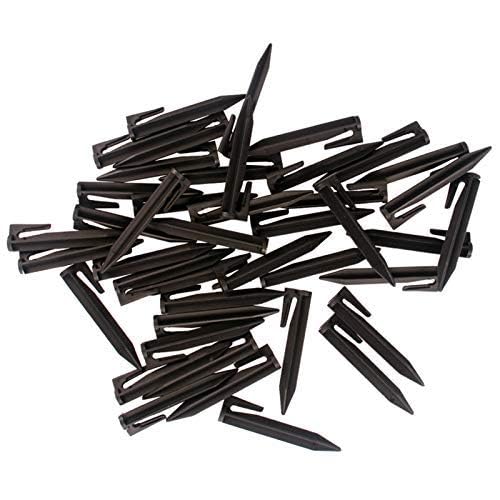
Pros
- Lightweight yet sturdy, won't break in normal soil conditions.
- Rust-proof and reusable, offering long-term value.
- Large 100-pack covers extensive areas without needing additional purchases.
- Versatile enough for both lawn and outdoor recreational use.
Cons
- Plastic may not be as strong as metal stakes in very hard or rocky soil.
- Length of 3.3 inches might be short for thick ground cover or deep anchoring.
- No customer reviews yet, so long-term durability is unverified.
The Bacetuao Lawn Stake Kit delivers 100 plastic pegs designed for securing boundary wire, garden netting, and outdoor gear. This set is a practical choice for homeowners with robot mowers, landscapers, or anyone needing reliable ground anchors for temporary or permanent setups.
Each stake is made from lightweight yet sturdy PP plastic that resists rust and deterioration. The black color stands out against grass and soil, making the stakes easy to see and avoid. The anchor shape grips the ground firmly, keeping wire, netting, or tarps in place even in windy conditions.
Installation is simple: just push the stakes into the soil by hand. They hold well in typical garden soil, but very hard or rocky ground may require pre-drilling or a mallet. The 3.3-inch length is adequate for most light-duty applications, though deeper anchoring might be needed for heavy tarps or thick mulch.
A key drawback is the lack of customer reviews, so long-term performance is untested. Additionally, while plastic avoids rust, it is less durable than metal stakes in extreme conditions. The included storage bag helps keep the set organized and prevents loss.
Overall, this stake kit offers excellent value for the price. It is a versatile, reusable solution for boundary wire, camping, and garden projects. For most users, the Bacetuao stakes will provide dependable performance without breaking the bank.

GPS-Based Navigation Systems
GPS models use satellite positioning to map your yard and stay within boundaries you set through a smartphone app. They work best on larger, open lawns where satellite signals are strong and unobstructed. GPS accuracy typically ranges from a few feet to several yards, depending on signal quality and atmospheric conditions.
The main limitation is that GPS signals weaken under dense tree cover, near tall buildings, or in areas with poor satellite visibility. You also need to physically mark or fence your yard’s actual edges, since GPS alone won’t prevent the mower from rolling into a flower bed or driveway. GPS models work well for large, relatively open properties but are less suitable for heavily wooded yards or small urban lawns.
Vision and Camera-Based Detection
Some robot lawn mowers without boundary wire use forward-facing cameras and AI image recognition to detect lawn edges, obstacles, and terrain changes. These systems can identify where grass ends and pavement or landscaping begins, then adjust course automatically. Camera-based models work regardless of weather or satellite availability.
Vision systems perform best in good lighting and struggle in heavy rain, fog, or low-light conditions like early morning or dusk. They also require clear visual contrast between your lawn and its surroundings, a yard that transitions gradually from grass to mulch or that has patchy, uneven growth may confuse the camera. These models are improving rapidly but remain less reliable than boundary-wire systems in challenging conditions.
Perimeter Edge and Cliff Detection Sensors
Edge-detection models use infrared or ultrasonic sensors to sense drops in ground level and changes in surface texture. When the mower approaches a driveway, deck, or steep slope, the sensors trigger a turn or stop. This passive approach works without cables or GPS signals and functions in any weather.
The trade-off is that edge detection alone cannot contain the mower within a specific zone, it only prevents it from falling or leaving the lawn. You still need physical barriers like fencing or walls to define where the mower should mow. Edge detection works well as a safety feature but is not a complete boundary solution on its own.
Hybrid and Multi-Sensor Approaches
Several newer models combine GPS, cameras, and edge sensors to compensate for each technology’s weaknesses. A hybrid system might use GPS as the primary boundary, camera vision to avoid obstacles, and edge sensors as a final safety layer. This redundancy improves reliability in mixed conditions.
Hybrid models tend to cost more than single-technology alternatives but deliver better performance across different yard types and weather conditions. They’re a good choice if your property has variable terrain, tree coverage, or weather patterns that would challenge a simpler system.
Yard Size and Layout Considerations
A robot lawn mower without boundary wire works best on open, relatively flat yards larger than half an acre. Smaller yards, narrow passages, or complex landscaping often frustrate wire-free systems because they lack a clear, unambiguous boundary to follow. GPS and camera systems can struggle with tight corners or areas where your lawn is interrupted by patios, garden beds, or decorative elements.
If your yard is small, heavily landscaped, or has significant tree cover, a traditional boundary-wire model may perform more reliably. Wire-free technology works better as a feature on larger properties where the mower has room to navigate and fewer obstacles to confuse its sensors.
Weather and Environmental Limitations
GPS models lose accuracy in heavy rain or dense cloud cover. Camera-based systems struggle in fog, darkness, or strong glare. All wire-free models perform worse during or immediately after rain when grass is wet and slippery, which affects how the mower detects edges and terrain.
If you live in a climate with frequent rain, early sunrises, late sunsets, or dense morning fog, a wire-free model’s limitations become more apparent during the seasons when you most need lawn care. Traditional boundary-wire systems are not affected by these conditions and continue working in rain, darkness, and poor visibility.
What to Do If You’re Considering a Robot Lawn Mower Without Boundary Wire
- Measure your yard and note its shape, wire-free models work best on open, rectangular or gently curved properties larger than half an acre.
- Assess your tree cover and satellite visibility by checking GPS signal strength in your yard using a smartphone or GPS app.
- Identify physical barriers already in place, fences, driveways, or landscaping that will contain the mower even if its sensors fail.
- Consider your local weather patterns and how often you have rain, fog, or low-light conditions during your typical mowing season.
- Test a wire-free model on your specific yard if possible, or read detailed user reviews from owners in similar climates and yard types.
If your yard is small, heavily shaded, or frequently wet, a traditional boundary-wire system remains the more reliable choice. Many users find that the convenience of wire-free operation is worth the trade-offs only on larger, open properties with predictable weather.
Frequently Asked Questions
Can a robot lawn mower without boundary wire mow my entire yard unsupervised?
Wire-free models can operate without human supervision, but they may wander into flower beds, driveways, or neighboring yards if their sensors fail or misread the landscape. Most owners keep physical barriers in place and periodically check that the mower stays on course, especially during the first few weeks of use.
Do I still need to install anything if I choose a robot lawn mower without boundary wire?
No buried wire is required, but you still need to set up the mower’s app, define your yard’s boundaries on a digital map, and often install physical barriers like fencing or edge stones. Some models also require a charging dock positioned in a specific location. Installation is simpler than burying a cable but still requires preparation.
How accurate is GPS on a robot lawn mower?
GPS accuracy typically ranges from three to ten feet, depending on satellite signal quality and atmospheric conditions. This is adequate for large, open lawns but too imprecise for small yards or areas where you need the mower to stop within inches of a garden bed or patio edge.
What happens if a robot lawn mower without boundary wire loses its signal?
GPS models may drift or stop moving if they lose satellite signal. Camera-based models struggle in darkness or fog. Most modern models have fallback behaviors, like returning to the charging dock or activating edge sensors, but performance degrades significantly. Physical barriers remain your last line of defense.
Are wire-free robot lawn mowers more expensive than traditional models?
Wire-free models with advanced GPS, camera, or hybrid sensor systems typically cost more than basic boundary-wire models because the technology is newer and more complex. However, you save money on installation labor and materials since no cable needs to be buried or maintained.
Related Guides
Final Thoughts
A robot lawn mower without boundary wire works well on open, larger yards with good satellite visibility and predictable weather, but struggles on small, complex, or heavily shaded properties. Before committing, honestly assess whether your yard’s size, layout, and climate match what wire-free technology can handle. If you’re still deciding which model to consider, our guide to robot lawn mower options can help you compare specific features and performance across different yard types.