

A robot mower typically takes between 1 and 4 hours to mow a standard suburban lawn, but the exact time depends on your lawn size, battery capacity, cutting width, and terrain complexity. For a 1,000-square-foot yard, expect roughly 1 to 2 hours of mowing per session. Most robot mowers run multiple times per week, cutting a small amount each time rather than doing the whole lawn at once, which keeps the grass consistently short and eliminates the need for a single long mowing session.
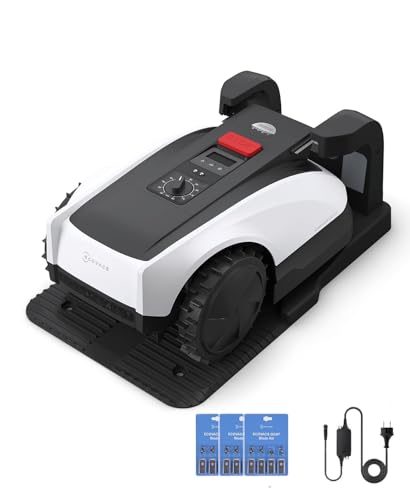
Pros
- Wire-free installation eliminates the hassle of burying perimeter wires.
- Centimeter-level accuracy ensures every part of the lawn is covered evenly.
- Extra blades reduce long-term maintenance costs and interruptions.
- Smart mapping adapts to irregular yard shapes and multiple zones.
- Fully automatic operation with auto recharge means true set-and-forget convenience.
Cons
- Initial setup may require careful placement of the RTK antenna for best signal reception.
- Limited to lawns up to 1/4 acre, so not suitable for larger properties.
- No built-in obstacle avoidance sensors or anti-theft features mentioned in the product data.
The ECOVACS Goat O1000 RTK CARE is a robotic lawn mower designed for homeowners with yards up to 1/4 acre who want a truly wire-free, hands-off mowing experience. It uses advanced RTK (Real-Time Kinematic) navigation to achieve centimeter-level positioning accuracy, eliminating the need for perimeter wires and random bump-and-turn patterns. This mower is ideal for those who value precision, efficiency, and low maintenance.
Standout features include the RTK precision navigation that follows systematic mowing paths for full coverage and cleaner lines. The CARE bundle adds 36 extra blades, significantly extending the time between blade replacements and keeping cutting performance sharp. The included RTK extension cable allows you to place the antenna in an optimal spot for strong satellite signals, crucial for reliable operation in yards with trees or other obstructions.
Design and build quality are solid, with a robust 44.5-pound chassis and dimensions that allow it to navigate typical residential lawns. The smart auto mapping feature quickly scans your yard and lets you create multiple zones via the app, so you can set different schedules for front, back, and side areas. The mower handles everything from path planning to automatic recharging, delivering a set-and-forget experience.
One potential drawback is that the initial setup requires careful antenna placement to ensure consistent signal reception, which may take some trial and error. Additionally, the 1/4 acre capacity means it is not suitable for larger properties, and the product data does not mention obstacle avoidance or anti-theft features. However, for its intended size range, the performance is reliable.
Overall, the ECOVACS Goat O1000 RTK CARE offers excellent value for homeowners seeking a wire-free, precise, and low-maintenance robotic mower. The extra blades and RTK extension cable enhance long-term usability, making it a strong choice for those with smaller, complex yards. It earns a recommendation for its accuracy, ease of use, and thoughtful bundle inclusions.
Brand: ECOVACS
Model: Goat O1000 RTK CARE
Coverage Area: Up to 1/4 acre
Navigation: RTK (Real-Time Kinematic) with centimeter-level accuracy
Included Accessories: 36 extra blades, RTK extension cable
Dimensions: 27.8 x 11.22 x 16.93 inches
Weight: 44.53 pounds
Color: O1000 RTK CARE
Product Group: Lawn & Patio

Pros
- No boundary wires or RTK stations needed, simplifying setup.
- Works in rain, darkness, and under trees, unaffected by weather or lighting.
- Precise 3D LiDAR and AI vision fusion for inch-level positioning and 95% coverage.
- App control with scheduling, mapping, and remote OTA updates.
- Easy maintenance with IPX5 waterproof rating and rinseable chassis.
Cons
- Battery runtime of 2 hours per charge covers only 0.17 acres, requiring multiple charges for full 0.75 acre.
- High price point compared to some wire-based robotic mowers.
- No customer reviews yet, so real-world performance is unverified.
The HOOKII Neomow X SE is a next-generation robotic lawn mower designed for homeowners with mid-sized lawns up to 0.75 acres. It eliminates the need for boundary wires or satellite-based RTK stations, using a combination of 360-degree 3D LiDAR and AI vision to navigate and map your yard. This makes it an excellent choice for those who want a hassle-free, wire-free setup and reliable mowing even in challenging conditions like rain, darkness, or under dense tree cover.
Standout features include its intelligent obstacle avoidance system, which can detect objects as small as 0.4 inches wide and 5.9 inches high, ensuring safety for children, pets, and even small wildlife. The mower achieves inch-level positioning accuracy and covers 95% of the lawn, reducing missed spots. With support for up to 40 customizable zones and no-go areas, you can easily protect flower beds, pools, or play areas via the app. The 3D LiDAR operates without network or satellite signals, making it truly independent.
Design and build quality are robust: the large front-wheel drive all-terrain wheels easily cross 1.6-inch obstacles, and the 11-inch floating deck adapts to uneven terrain while preventing grass clippings buildup. The IPX5 waterproof rating allows simple cleaning with a water jet. The base station can be placed indoors or in a garage to prevent theft, and the mower resumes mowing after recharging thanks to breakpoint resume functionality.
Potential drawbacks include the battery runtime: a single 2-hour charge covers only 0.17 acres, so you may need multiple charging cycles for larger lawns. The price is higher than some wired alternatives, and as a new model, there are no customer reviews yet to confirm long-term reliability. However, the feature set and technology are impressive for the price point.
Verdict: The HOOKII Neomow X SE is a highly capable, wire-free robotic mower that excels in versatility and precision. It is best suited for tech-savvy homeowners who value convenience, smart controls, and the ability to mow in any weather. If you have a 0.5 to 0.75 acre lawn and want a premium, hassle-free mowing experience, this mower is a strong contender.
Color: Gray
Dimensions: 35 x 16 x 22 inches
Weight: 38 pounds
Battery: 13,000 mAh, up to 2 hours runtime
Coverage per charge: 0.17 acres (7,535 sq. ft)
Maximum lawn size: 0.75 acres
Cutting height: 1.18 to 3.35 inches (30 to 85 mm)
Deck width: 11 inches (280 mm)
Obstacle crossing: up to 1.6 inches (4 cm)
Navigation: 360° 3D LiDAR + AI Vision fusion
Connectivity: WiFi, Bluetooth, 4G (1GB free data)
Waterproof rating: IPX5
Product Group: Lawn & Patio

Pros
- Wire-free setup saves time and eliminates the need for perimeter wire installations.
- Combines robot mower and grass trimmer in one kit, covering both mowing and edging tasks.
- Optical navigation performs well even in high-contrast lighting, ensuring efficient grass identification.
- Obstacle avoidance and magnetic strip virtual fence provide flexible control of mowing boundaries.
- Capable of climbing moderate slopes, making it suitable for varied small lawn layouts.
Cons
- Requires clearly defined lawn edges; the mower may leave the grass if edges are not well-maintained.
- Rated for up to 4000 sq ft but needs an additional battery charge to cover the full area in one session.
- No smartphone app or smart home integration limits automation and remote control options.
The LawnMaster OcuMow Robot Lawn Mower and Trimmer Combo Kit (B0D2L5PWRS) is designed for homeowners with small to medium yards (2000-4000 square feet). It stands out by eliminating the need for a buried perimeter wire using optical navigation technology. Instead, the mower uses a wide-angle, high-dynamic-range camera to identify grass and navigate your lawn efficiently. This makes setup as simple as placing the mower on the grass, pressing start, and letting it work.
Key standout features include its dual ultrasonic sensors for obstacle avoidance, detecting objects as small as 6 inches and redirecting the mower automatically. The included 33-foot magnetic strip allows you to create no-go zones without any power source or digging. Additionally, the combo kit comes with a cordless grass trimmer (10-inch cutting width) for edge work, providing a complete lawn maintenance solution. The mower can also climb slopes up to 35% (19 degrees), adding versatility.
In terms of design and build, the OcuMow sports a sturdy orange body with deep-tread wheels for grip on uneven terrain. The 24V MAX battery system (nominal 21.6V) powers both the mower and the trimmer, with two batteries included. The mower's runtime varies, and for full coverage of a 4000 sq ft lawn, an additional battery charge might be needed. The trimmer features an adjustable handle, auto line feed, and a pivoting head for precision edging.
However, there are a few drawbacks to consider. The mower requires a clearly defined lawn edge around the full perimeter; if edges are unkempt, the mower may drift off the grass. Also, the lack of a smartphone app means you cannot schedule mowing remotely or track the mower's progress. While the magnetic strip is a clever solution, it is limited to 33 feet, so larger no-go zones may require extra strips (sold separately). Finally, the product has no customer reviews yet, so real-world long-term reliability is unverified.
Verdict: The LawnMaster OcuMow combo kit offers a compelling, wire-free approach to robotic mowing for small lawns. Its included trimmer, optical navigation, and obstacle avoidance make it a solid choice for homeowners who want a simple, no-fuss setup. However, if you need smart features or have a lawn larger than 4000 sq ft, you may need to look elsewhere. For its price point and included tools, it provides good value for the target audience.

Pros
- No boundary wire or local antenna required for precise navigation
- Vision AI obstacle avoidance and cut-to-edge brushes reduce manual trimming
- Unlimited mowing zones, no-go areas, and four precision patterns via app
- V-SLAM sensor fusion keeps navigation reliable in shaded or partially covered areas
- RadioLink extends control beyond standard Wi-Fi range for larger lawns
Cons
- Designed for up to 1/4 acre lawns, so it is not suitable for larger yards.
- Full feature set depends on the app and a stable network connection during setup and operation.
- As a newer release, long-term field performance is not yet widely documented.
The WORX Wire-Free Robot Lawn Mower is designed for homeowners with up to 1/4 acre of grass who want precise, hands-off mowing without the hassle of laying boundary wire. It replaces perimeter cables with RTK Cloud positioning and Vision AI, so the robot learns your lawn, plans efficient routes, and returns to its charging station on its own.
In real-world use, the standout combination of centimeter-level RTK accuracy and V-SLAM sensor fusion keeps navigation stable in both open yards and shaded areas. Vision AI also recognizes common obstacles and border types, helping the mower avoid toys, flower beds, and other objects while cutting closer to edges using wheel brushes and cut-to-edge logic.
The app adds a high level of control: you can create unlimited mowing zones, set no-go areas, customize paths, and choose from Parallel, Checkerboard, Diamond, or Natural patterns. RadioLink connectivity extends communication beyond typical Wi-Fi range, which is useful for larger properties and hard-to-reach corners of the yard.
Build quality appears solid, with a two-wheel driver, durable brushes, spare blades, and a charging station included. The main drawbacks are the 1/4 acre size limit and the need for a smartphone for full setup and control. Since this is a new release, long-term reliability data is still limited, so it is best suited for early adopters who value advanced navigation and convenience.
Overall, the WORX robot mower offers a wire-free, app-driven mowing experience that is hard to match at this level of technology. For homeowners with a smaller lawn who want clean stripes, obstacle avoidance, and minimal setup, it is a compelling choice.
Color: Black/Orange; Size: Up to 1/4 Acre; Dimensions: 22.7 x 18.1 x 11.3 inches; Weight: 39.2 pounds.
Navigation: RTK Cloud precision with Vision AI and V-SLAM sensor fusion; Obstacle avoidance via neural processing; Connectivity: Bluetooth, Wi-Fi, and RadioLink.
In the box: Vision Cloud two-wheel driver, wheel brushes, 6 spare blades, charging station, other accessories, and product guide.

Pros
- No boundary wire installation needed, saving time and effort.
- RTK+Vision navigation provides precise and reliable mowing.
- Advanced obstacle avoidance protects lawn items and pets.
- Fully customizable via app for personalized lawn care.
- Automatic scheduling frees up your weekends.
Cons
- Maximum lawn size of 1/4 acre may not accommodate larger yards.
- The initial setup requires a clear line of sight for RTK base station (typical for RTK systems).
- The product is new with no customer reviews, so long-term reliability is unknown.
The ECOVACS Goat O1000 RTK is a wire-free robot lawn mower designed for homeowners with lawns up to 1/4 acre. It eliminates the need for boundary wires, using RTK and Vision technology for precise navigation and mapping. This makes it an ideal choice for those who want automated lawn care without the installation hassle.
The standout feature is the RTK+Vision+3D ToF navigation system that provides centimeter-level accuracy. Combined with AIVI 3D obstacle avoidance, the mower can detect and avoid furniture, toys, and pets while navigating narrow passages and slopes. In real-world use, this means reliable mowing with minimal intervention.
The Goat O1000 RTK has a compact design at 23.6 x 10.4 x 15.8 inches and weighs 23.6 pounds. It is built with durable materials to withstand outdoor conditions. The TruEdge edge cutting system ensures clean cuts along borders, giving a manicured look to your lawn.
One potential drawback is the lawn size limit of 1/4 acre, which may not be enough for larger properties. Additionally, the price is on the higher end, and the product is new with no customer reviews yet, so long-term reliability is not proven. Battery life information is also not provided, which could be a concern for larger lawns.
Overall, the ECOVACS Goat O1000 RTK is a feature-rich robot mower that offers convenience and precision. It is best suited for small to medium lawns where wire-free installation is a priority. If you are looking for a fully automated mowing solution with advanced navigation, this is a strong contender.
Dimensions: 23.62 x 10.35 x 15.75 inches
Weight: 23.58 pounds
Color: Black
Product Group: Lawn & Patio

Lawn Size and Shape
The most obvious factor is the total area of your lawn. A robot mower cuts at a steady pace, so doubling the lawn size roughly doubles the time needed. However, shape matters more than raw area. A long, narrow lawn forces the mower to make many turns, which slows it down compared to a square or rectangular yard of the same square footage.
Irregular shapes with lots of obstacles, like flower beds, trees, or pathways, also increase mowing time because the robot must navigate around them. The mower’s path planning algorithm has to handle these interruptions, adding extra minutes per pass.
Battery Capacity and Charging Cycles
Robot mowers run on rechargeable batteries, and battery capacity directly limits how long they can mow before returning to the charging station. Typical run times range from 60 to 120 minutes per charge, depending on the model. A robot that can only mow for 90 minutes will need to recharge for 60 to 90 minutes before resuming, effectively doubling the total time to finish a large lawn.
Some mowers automatically resume mowing after charging, but the downtime adds up. If your lawn requires more than one full charge cycle, the total mowing duration can stretch across several hours or even a full day.
Cutting Width and Blade Design
The width of the cutting deck determines how much grass the robot can cover in one pass. A wider cutting deck (say 12 inches or more) will mow faster than a narrower one (8 inches), because it takes fewer passes to cover the same area. Blade design also matters: some mowers use a single spinning blade, while others use a floating disc that cuts more efficiently.
Keep in mind that a wider cutting deck often means a larger, heavier robot, which can be slower on slopes or tight spaces. So there is a trade-off between speed per pass and maneuverability.
Terrain Complexity and Slope
Hills, uneven ground, and steep slopes force the robot to work harder. On a 10-degree slope, a mower may slow down to maintain traction and avoid slipping. The motor draws more power, which can reduce battery runtime by 20 to 30 percent. If your lawn has multiple slopes, the robot will spend more time navigating them, adding to the overall mowing time.
Flat, even terrain allows the mower to maintain a consistent speed and cover ground quickly. Complex terrain also increases the number of boundary wire turns and obstacle avoidance maneuvers, each of which adds seconds to the journey.
Mowing Schedule and Frequency
Robot mowers are designed to mow frequently, often daily or every other day, rather than once a week like a traditional mower. This means each mowing session cuts only a small amount of grass, so the mower can run for a shorter period each time. For example, a robot might mow for 45 minutes each morning, keeping the lawn at a constant height without ever needing a long session.
If you set a less frequent schedule, the grass grows taller between cuts, and the robot must spend more time per session to bring it down. That can increase the total time per week, even though the number of sessions decreases.
Grass Type and Growth Rate
Fast-growing grass species, like Bermuda or ryegrass, require more frequent mowing. During peak growing season, the robot may need to run longer sessions to keep up. Slower-growing grasses, such as fescue, allow shorter mowing times. The robot’s cutting height setting also affects time: a lower cut removes more grass per pass, but the mower may need to go slower or make multiple passes to avoid scalping.
Wet grass is heavier and clumps, which can clog the cutting deck and force the robot to stop or slow down. Avoid mowing right after rain or irrigation to keep the session efficient.
How to Estimate Your Robot Mower’s Mowing Time
- Measure your lawn area in square feet and note its shape (simple vs. complex).
- Check your robot mower’s battery runtime and cutting width from the manual.
- Account for charging time: if lawn area requires more than one charge, add 60-90 minutes per charge cycle.
- Consider slope: multiply estimated time by 1.2 for moderate slopes, 1.5 for steep slopes.
- Set a frequent mowing schedule (daily or every other day) to reduce per-session time.
- Keep grass at a moderate height (2.5-3 inches) to avoid overworking the mower.
Once you have a rough estimate, you can adjust your robot’s schedule or even consider a model with a larger battery or wider cutting deck if your lawn is on the larger side. For more details on choosing the right mower for your yard, browse our blog for tips and comparisons.
Frequently Asked Questions
How long does a robot mower take to mow 1/2 acre?
For a half-acre lawn (about 21,780 square feet), a robot mower with a typical 90-minute battery and 10-inch cutting deck will take roughly 4 to 6 hours of actual mowing time, spread over multiple charging cycles. Depending on the schedule, it may complete the job over two days.
Can a robot mower mow too fast?
Robot mowers are designed to move slowly for safety and cutting quality. Speeding up would reduce cut quality, increase battery drain, and raise the risk of hitting obstacles. The pace is intentionally set to balance efficiency with a clean, even cut.
Does rain affect robot mower mowing time?
Yes, rain can slow down or stop the mower. Many robots have rain sensors that send them back to the charging station to avoid damage. Mowing in wet grass also reduces efficiency because the clippings clump and the mower may need to make additional passes.
How often should I run my robot mower?
Most manufacturers recommend running the robot daily or every other day during the growing season. This keeps the grass at a consistent height and reduces the time needed per session. In cooler months, you can schedule less frequent mowing.
Why does my robot mower take longer than expected?
Common reasons include a complex lawn shape, steep slopes, a narrow cutting deck, or a battery that needs replacement. Also, check for obstacles like fallen branches or toys that the robot must navigate around. Adjusting the schedule or clearing the lawn can help.
Related Guides
- Can You Use a Robot Mower on Any Lawn?
- How Do Robot Lawn Mowers Work
- How to Store Robot Mower for Winter
Closing
A robot mower’s mowing time depends on lawn size, shape, battery, cutting width, terrain, and schedule. By understanding these factors, you can set realistic expectations and optimize your robot’s runtime. For a deeper dive into specific models and their performance, check out our blog for guides and reviews.


