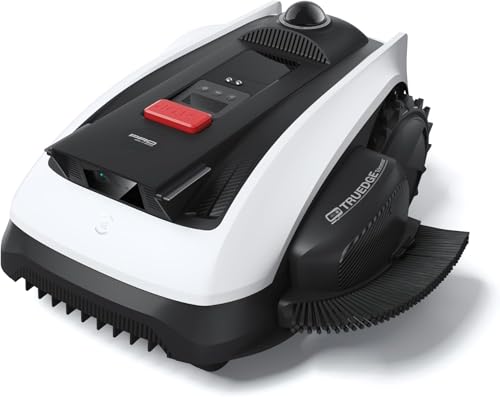
Robot lawn mowers find their charging station using a combination of boundary wires, radio signals, and onboard navigation sensors that guide them back to the dock when their battery runs low. Most models rely on a perimeter wire buried or laid around your yard’s edge, which creates an invisible boundary the mower recognizes. Once the battery reaches a set threshold, the mower’s internal system activates its homing routine and follows the signal back to where it started.

Pros
- Excellent all-weather protection for your robot mower.
- Sturdy steel frame with rust-proof coating.
- Wide compatibility with numerous robot mower brands.
- Quick and secure installation with anchor bolts.
- Aesthetic design integrates well into garden decor.
Cons
- No user reviews yet to verify real-world performance.
- Must store mower frost-free if temperatures drop below freezing.
- Only available in gray color, which may not suit all preferences.
The CNAINFC Plus Size Garage for Robot Lawn Mower is a practical shelter designed to protect your investment from the elements. It's ideal for homeowners who want to shield their robotic mower from rain, snow, hail, UV rays, and debris, thereby extending its lifespan. This garage is compatible with a wide range of popular brands, including Ecovacs, Husqvarna, Worx, and many others, making it a versatile choice for most users.
Standout features include a rust-proof spray-coated steel frame and a thickened 600D high-density waterproof oxford fabric canopy. These materials ensure durability and reliable weather protection. The garage is easy to install on both lawns and hard surfaces, with eight 7-inch stainless steel anchor bolts that keep it firmly in place. The generous dimensions (35 x 35 x 17 inches) accommodate most robot mowers comfortably, allowing them to enter from the side for charging or shelter.
Design-wise, the white roof gives the garage a clean, tent-like appearance that blends naturally into garden settings. The overall construction feels solid for its weight (4.9 pounds), though the fabric canopy may require periodic cleaning. The ability to disassemble and store the garage during winter is a convenient bonus, especially in colder climates where the mower itself needs to be kept frost-free.
One potential drawback is the lack of user reviews, so long-term durability is unverified. Additionally, the garage is only available in gray, which may not match every garden aesthetic. The instructions advise storing the mower indoors when temperatures drop below freezing, as the garage itself does not provide insulation.
Overall, the CNAINFC Plus Size Garage offers a cost-effective, well-built solution for protecting your robot lawn mower. Its robust materials, easy installation, and broad compatibility make it a strong contender for anyone seeking to prolong their mower's life. If you value weather protection and simplicity, this garage is a solid investment.


Pros
- No boundary wire installation needed, saving time and effort.
- RTK+Vision navigation provides precise and reliable mowing.
- Advanced obstacle avoidance protects lawn items and pets.
- Fully customizable via app for personalized lawn care.
- Automatic scheduling frees up your weekends.
Cons
- Maximum lawn size of 1/4 acre may not accommodate larger yards.
- The initial setup requires a clear line of sight for RTK base station (typical for RTK systems).
- The product is new with no customer reviews, so long-term reliability is unknown.
The ECOVACS Goat O1000 RTK is a wire-free robot lawn mower designed for homeowners with lawns up to 1/4 acre. It eliminates the need for boundary wires, using RTK and Vision technology for precise navigation and mapping. This makes it an ideal choice for those who want automated lawn care without the installation hassle.
The standout feature is the RTK+Vision+3D ToF navigation system that provides centimeter-level accuracy. Combined with AIVI 3D obstacle avoidance, the mower can detect and avoid furniture, toys, and pets while navigating narrow passages and slopes. In real-world use, this means reliable mowing with minimal intervention.
The Goat O1000 RTK has a compact design at 23.6 x 10.4 x 15.8 inches and weighs 23.6 pounds. It is built with durable materials to withstand outdoor conditions. The TruEdge edge cutting system ensures clean cuts along borders, giving a manicured look to your lawn.
One potential drawback is the lawn size limit of 1/4 acre, which may not be enough for larger properties. Additionally, the price is on the higher end, and the product is new with no customer reviews yet, so long-term reliability is not proven. Battery life information is also not provided, which could be a concern for larger lawns.
Overall, the ECOVACS Goat O1000 RTK is a feature-rich robot mower that offers convenience and precision. It is best suited for small to medium lawns where wire-free installation is a priority. If you are looking for a fully automated mowing solution with advanced navigation, this is a strong contender.
Dimensions: 23.62 x 10.35 x 15.75 inches
Weight: 23.58 pounds
Color: Black
Product Group: Lawn & Patio

Pros
- No perimeter wire needed for installation.
- 10-minute automatic yard mapping.
- Precise navigation with dual AI vision and RTK.
- Recognizes over 1,000 obstacles for enhanced safety.
- Handles steep slopes up to 45%.
Cons
- Covers only up to 0.15 acre, limiting use to small yards.
- Requires initial setup of the RTK reference station, which may take extra time.
- No established user reviews yet, so long-term performance is unverified.
The ANTHBOT M5 is a wire-free robotic lawn mower designed for small yards up to 1/8 acre. It uses dual AI vision and full-band RTK positioning to navigate without a perimeter wire, making it ideal for homeowners who want a clean, modern setup without the hassle of burying cables.
In real-world use, the M5 maps your yard automatically in just 10 minutes via the app. Its dual cameras recognize over 1,000 common obstacles, from toys to garden tools, ensuring safe and effective mowing. The RTK system provides centimeter-level accuracy, even in challenging conditions, and the mower handles slopes up to 45% with ease.
The build quality feels solid with a gray finish and compact dimensions. It includes a charging base station, RTK reference station, and five blades. The cutting height adjusts from 1.2 to 2.7 inches, and the five free-rotating blades create a carpet-like finish. Operating noise is low at 58 dB, so it won't disturb neighbors.
However, the M5 is limited to small lawns (0.15 acre max), which may not suit larger properties. The RTK reference station requires additional setup, and since there are no user reviews yet, long-term reliability remains to be seen. Also, the price point is higher than some basic wire-guided models.
Overall, the ANTHBOT M5 is an excellent choice for small-yard owners who want a smart, wire-free mowing solution with advanced obstacle avoidance. Its quick mapping, multi-zone management, and quiet operation make it a standout option for tech-savvy homeowners seeking convenience and precision.
Color: Gray
Dimensions: 19.61 x 15.43 x 9.88 inches
Weight: 21.6 pounds
Max Mowing Area: 0.15 acre (1/8 acre)
Cutting Height: 1.2 to 2.7 inches
Maximum Slope: 45%
Operating Noise: ≤58 dB
Obstacle Recognition: Over 1,000 objects
Number of Zones: Up to 20
Package Contents: Mower, charging base station, RTK reference station, 5 blades
Perimeter Boundary Wire Navigation
The boundary wire is the primary navigation tool for most robot lawn mowers. This wire runs around the perimeter of your yard and emits a low-voltage radio signal that the mower’s receiver detects.
When the mower’s battery level drops to around 20-30 percent, it stops cutting and enters search mode. It then follows the boundary wire signal back toward the charging station, which is typically positioned along or near the wire’s path. The mower uses the signal strength to stay on course, moving toward stronger signal areas that lead directly to the dock.
If the boundary wire is damaged, disconnected, or poorly installed, the mower may struggle to locate the signal. This is one of the most common reasons a robot lawn mower fails to find its charging station reliably.
Radio Frequency Homing Signals
Beyond the perimeter boundary, many robot lawn mowers emit and receive radio frequency signals specifically designed to help them dock. The charging station itself broadcasts a homing signal that intensifies as the mower gets closer.
This secondary signal acts as a fine-tuning mechanism once the mower is within range of the dock. Even if the boundary wire signal is weak or interrupted, the mower can still lock onto the dock’s direct RF beacon and align itself for charging. This is why mowers often perform better when the charging station is placed in an open area rather than tucked into a corner or behind obstacles.
Onboard Sensors and Gyroscopes
Modern robot lawn mowers include internal motion sensors, gyroscopes, and sometimes cameras that help them build a mental map of your yard. These sensors track the mower’s movement and position relative to where it started, creating a form of internal navigation memory.
If the mower gets turned around or disoriented, these sensors help it reorient itself and continue moving toward the dock. Some higher-end models use GPS or visual mapping to supplement wire-based navigation, though GPS alone is rarely accurate enough for reliable docking without a boundary wire.
Charging Dock Placement and Alignment
The physical location of your charging dock directly affects how easily the mower finds it. The dock should be placed on level ground with clear space on both sides and in front of it, ideally in a shaded area to prevent battery degradation from heat.
The dock’s position relative to the boundary wire matters too. Most manufacturers recommend placing it along the boundary line or at a specific distance from it so the mower’s homing signal and boundary detection work together. If the dock is hidden behind trees, buildings, or obstacles, the radio signals weaken and the mower may miss it even when it’s close.
Boundary Wire Gaps and Return Paths
Your boundary wire must form a complete loop with no breaks or gaps. If you have gates, driveways, or areas where the wire is interrupted, the mower loses the signal path and cannot reliably navigate home.
Some yards need a dedicated return path, which is a second wire that runs from the dock to the far edge of the mowing area. This wire guides the mower back along a specific route rather than forcing it to search randomly. Without a return path, the mower relies entirely on its RF homing signal to find the dock once it loses the boundary wire.
What to Check If Your Mower Can’t Find Its Dock
- Inspect the entire boundary wire for cuts, loose connections, or damage where it enters the dock.
- Verify the dock is powered on and positioned exactly where you installed it initially, with clear space around it.
- Check that the boundary wire forms a complete loop with no gaps or interruptions.
- Move the dock away from metal objects, large trees, or buildings that might block radio signals.
- Test the mower’s battery level to ensure it’s not completely drained, which can prevent homing behavior.
- Consult your mower’s manual to confirm the dock is placed at the correct distance from the boundary wire.
If your mower still cannot find the dock after checking these items, the receiver or transmitter components may need service. Most manufacturers offer troubleshooting guides specific to their models that can help pinpoint whether the issue is wire-related, signal-related, or hardware-related.
Frequently Asked Questions
Can a robot lawn mower find its charging station without a boundary wire?
Most traditional models cannot reliably dock without a boundary wire because they depend on it as their primary navigation tool. Some newer models use GPS or visual mapping, but even these typically work best when paired with a boundary wire for accuracy and backup navigation.
How far can a robot lawn mower’s homing signal reach?
The dock’s homing signal typically reaches 50 to 100 feet depending on the model and interference from obstacles. This range is usually sufficient for residential yards, but metal structures or dense vegetation can reduce it significantly.
What happens if the boundary wire breaks in the middle of the yard?
If the boundary wire breaks, the mower loses the signal on one side of the break. It will not be able to cross the broken section to reach the dock and may become stuck or wander until its battery dies.
Does rain or wet grass affect how a robot mower finds its dock?
Rain and wet conditions can slightly weaken radio signals, but they rarely prevent docking entirely. The boundary wire signal is buried or laid on the ground and remains stable in wet weather. However, extremely poor signal strength from other causes becomes more noticeable during rain.
Can I move my charging station to a different location?
You can move the dock, but you must also adjust the boundary wire position to match the new dock location. Moving only the dock without repositioning the wire will confuse the mower’s navigation system and prevent reliable docking.
Related Guides
Wrapping Up
Robot lawn mowers find their charging station through a combination of boundary wire signals, radio frequency homing beacons, and onboard sensors that work together to guide them home when the battery runs low. The most common reason a mower fails to dock is a damaged or improperly installed boundary wire, or a dock placed in a location with poor signal reception.