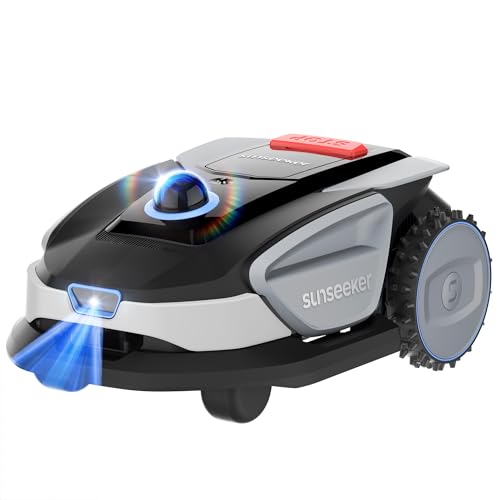
Robot lawn mowers navigate by combining boundary wires, sensors, and onboard software to create a systematic cutting pattern across your lawn. The most common method uses a buried wire that defines the mowing area, while the mower detects the wire’s signal to stay within bounds. More advanced models add GPS, cameras, or laser sensors to map the yard and avoid obstacles, allowing for more efficient coverage without a physical wire. Understanding how your robot mower navigates helps you set up the boundary correctly and troubleshoot any issues. The navigation method directly affects how evenly the grass is cut and how long the mower takes to finish the job.

Pros
- No perimeter wires required, saving installation time and avoiding tripping hazards.
- Integrated edge trimmer eliminates the need for a separate trimmer for lawn borders.
- Advanced obstacle avoidance keeps the mower safe around people and pets.
- Fast recharge and automatic resume means minimal downtime.
- Accurate mapping works in low light and under trees.
Cons
- High upfront cost compared to wire-based robotic mowers.
- Requires a stable Wi-Fi connection for app features and firmware updates.
- May struggle with very steep slopes or extremely uneven terrain (not specified but typical for such mowers).
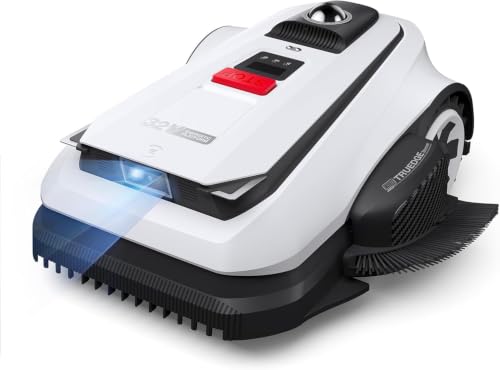
The ECOVACS Goat A2000 LiDAR PRO is a high-end robotic lawn mower designed for homeowners with medium-sized lawns up to half an acre. It stands out by eliminating the need for perimeter wires, using dual-LiDAR technology to map and navigate your yard autonomously. This mower is ideal for those who want a premium, hands-free mowing experience with minimal setup.
Its dual-LiDAR navigation system, called HoloScope 360, combines a rotating LiDAR with 3D-ToF LiDAR for precise positioning even under trees or at night. The built-in TruEdge string trimmer automatically cuts along borders, reducing manual trimming. The dual-blade cutting system with a 13-inch path handles thick grass efficiently, and the cutting height adjusts electronically via the app.
The mower has a robust white plastic body with dimensions of 30x17x23 inches. It features AIVI 3D obstacle avoidance that recognizes over 200 objects, ensuring safe operation around pets and children. The 32V battery system recharges in about 50 minutes, and the mower resumes unfinished tasks automatically, minimizing downtime.
The main drawback is the price, which is significantly higher than many wire-based competitors. Additionally, the mower relies on a strong Wi-Fi connection for full functionality, which could be an issue in remote areas. The lack of published reviews means long-term reliability is unverified, though ECOVACS is a known brand in robotics.
Overall, the ECOVACS Goat A2000 LiDAR PRO offers cutting-edge navigation and trimming features that justify its premium price for tech-savvy lawn owners. If you want a wire-free, intelligent mower that can handle complex yards with minimal intervention, this is a strong contender. However, budget-conscious buyers may want to consider alternatives.

Pros
- No boundary wires needed, simplifies setup and maintenance.
- Visual navigation effectively avoids obstacles and adapts to lawn layout.
- Adjustable cutting height accommodates various grass types and slope conditions.
- Safety features like tilt and rain sensors prevent accidents and damage.
- Comes with accessories including extra blades and magnetic strip for no-go zones.
Cons
- Random mowing pattern may be less efficient than systematic coverage.
- Magnetic strip length may be insufficient for larger or complex no-go areas.
- Battery life not specified, may require frequent recharging for larger lawns.
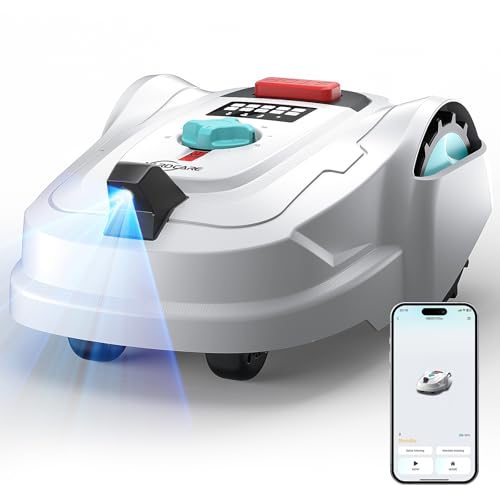
The YARDCARE V100 robot lawn mower is designed for homeowners with small lawns up to 1600 square feet. It stands out with its HD vision system that uses a camera and AI to navigate, avoiding obstacles and distinguishing grass from non-grass areas. This makes it an excellent choice for those who want a hands-off mowing experience without the hassle of laying boundary wires.
In real-world use, the V100's visual navigation is a game-changer. It detects up to 150 different obstacles and adjusts its path after a collision, ensuring thorough coverage. The included 32-foot magnetic strip lets you create no-go zones easily, protecting flower beds or play areas. The random mowing path is effective for routine maintenance, though it may occasionally miss spots that a systematic pattern would cover.
Build quality is solid with an ash gray finish and durable construction. The adjustable cutting height from 0.8 to 2.4 inches and ability to handle slopes up to 20 degrees adds versatility. Safety features like the tilt sensor and rain sensor provide peace of mind, automatically stopping the blades when lifted or in rain. The 4Ah battery is replaceable, extending the mower's lifespan.
Potential drawbacks include the random mowing pattern, which may lead to longer mowing times on complex lawns. The magnetic strip length is adequate for small yards but might need extension for larger no-go areas. Battery runtime is not specified, so users with lawns at the upper size limit may need to recharge mid-cycle.
Overall, the YARDCARE V100 is a reliable, feature-rich robot mower for small lawns. Its wire-free setup and smart navigation make it a top pick for tech-savvy homeowners seeking convenience. While not perfect for large or intricate landscapes, it delivers excellent value for its price point.

Pros
- Wire-free setup saves time and eliminates boundary wire installation
- High precision navigation near trees and buildings for continuous mowing
- Long 200-minute runtime with fast 180-minute charge cycle
- Comprehensive warranty (3-year mower, 2-year battery) for peace of mind
- Quiet operation at 60dB suitable for noise-sensitive areas
Cons
- No user reviews yet to confirm real-world performance and reliability
- Free NetRTK service only during warranty period; subscription may be required afterward
- Initial mapping setup may require careful app-guided configuration for complex yards
The LOPKIN L2500-NEO is a high-tech robotic lawn mower designed for medium-sized yards up to 0.9 acres. It eliminates the need for boundary wires by combining NetRTK, AI vision, and GNSS/INS fusion for accurate navigation. This mower is ideal for tech-savvy homeowners who want a hands-free mowing experience with the freedom to manage multiple zones from their phone.
The standout feature is the Wi-Fi HaLow connectivity, which provides a stable connection over long distances, even through obstacles. The AI vision system can identify and avoid over 300 objects, reducing the risk of collisions with pets, toys, or garden furniture. With a quiet 60dB operation, it won't disturb your outdoor peace.
The mower has an IP66-rated housing, making it dust and water resistant for reliable outdoor use. The adjustable cutting height from 1.18 to 2.76 inches suits different grass types. The 8Ah battery delivers up to 200 minutes of mowing per charge, and the 5A fast charger replenishes it in about 180 minutes.
While the technology is advanced, there are no verified user reviews yet, so long-term reliability is unproven. The free NetRTK service is only included for the warranty period; after that, a subscription may be required. Setting up the mapping for complex lawns might take some patience initially.
Overall, the LOPKIN L2500-NEO offers a compelling package for those seeking a wire-free robotic mower with cutting-edge navigation and obstacle avoidance. Its strong warranty and feature set justify its price. If you are willing to be an early adopter, this mower could simplify your lawn care routine.

Boundary Wire Navigation
The most widely used navigation method for robot lawn mowers is a boundary wire. You bury an insulated wire around the perimeter of your lawn and through any narrow passages you want the mower to avoid. The mower’s sensor detects the low-voltage signal running through the wire and uses it as a virtual fence.
Once inside the boundary, the mower typically follows one of two movement patterns: random or systematic. Random patterns bounce off the wire at different angles, eventually covering the entire lawn. Systematic patterns, such as parallel stripes or spiral paths, require more onboard processing but cut more efficiently.
GPS and RTK Navigation
Some robot mowers use GPS signals to define the mowing area without a physical wire. A base station with real-time kinematic (RTK) correction improves accuracy to within a few centimeters. This method works well on large or complex lawns where burying a wire is impractical.
GPS navigation allows the mower to create a digital map of your yard. It can then plan efficient routes and return to the charging station automatically. However, GPS signals can be blocked by tall trees or buildings, which may cause the mower to lose its position temporarily.
Vision-Based Navigation (Cameras)
Advanced robot mowers use cameras to see their surroundings. The mower captures images of the lawn and nearby objects, then uses computer vision to identify the grass, obstacles, and boundaries. This allows it to navigate without any wire or GPS signal.
Camera-based navigation excels at avoiding obstacles like toys, garden furniture, and flower beds. The mower can recognize these objects and steer around them. Low light or tall grass can reduce camera effectiveness, so many models combine cameras with other sensors.
Laser and LiDAR Navigation
LiDAR (Light Detection and Ranging) uses laser pulses to create a 3D map of the environment. Robot mowers with LiDAR can detect obstacles and measure distances with high accuracy.
LiDAR allows the mower to navigate in complete darkness and through dust or light rain. It can also detect changes in terrain, such as slopes or drop-offs. The main drawback is the higher cost of the sensor, which increases the mower’s price.
Inertial Sensors and Gyroscopes
Most robot mowers include inertial measurement units (IMUs) that track acceleration and rotation. Gyroscopes help the mower maintain a straight line and turn accurately. These sensors are essential for systematic patterns, where the mower must know its heading.
IMUs alone cannot determine absolute position, so they are always used alongside another navigation method. They provide short-term stability and help the mower correct its course when crossing uneven ground or slopes.
Hybrid Navigation Systems
Many modern robot mowers combine two or more navigation methods for better reliability. For example, a mower might use a boundary wire for perimeter definition, GPS for area mapping, and cameras for obstacle avoidance. This redundancy ensures the mower can continue working even if one sensor fails.
Hybrid systems also allow the mower to adapt to different conditions. If GPS signal is lost under a tree, the mower can rely on its inertial sensors and wire signal until it regains satellite lock. The result is more consistent coverage and fewer stuck or lost mowers.
How to Optimize Your Robot Mower’s Navigation
- Inspect the boundary wire for breaks or poor connections that could disrupt navigation.
- Trim tree branches or tall structures that block GPS signals for mowers using satellite navigation.
- Clean camera lenses and LiDAR sensors regularly to maintain obstacle detection accuracy.
- Update the mower’s firmware to benefit from the latest navigation algorithms and bug fixes.
- Remove loose objects like toys, hoses, and garden tools from the lawn to prevent sensor confusion.
Related Guides
- How Does a Robot Lawn Mower Cut Grass?
- How Do Robot Lawn Mowers Find Their Charging Station
- Best Robot Mower Garage That Does Not Block Signal in
- Best Garage for GPS Robot Mower in
Frequently Asked Questions
Do all robot lawn mowers need a boundary wire?
No, not all robot mowers require a boundary wire. Models with GPS or vision-based navigation can define the mowing area digitally without a physical wire. However, wire-based systems remain the most common and affordable option, especially for smaller yards.
How does a robot mower find its charging station?
Most robot mowers return to the charging station by following the boundary wire back to the dock. Some advanced models use GPS coordinates or a homing beacon to locate the station. The mower typically starts searching when its battery drops below a set threshold.
Can robot mowers navigate on slopes?
Yes, many robot mowers can handle slopes up to a certain incline, typically between 15 and 25 degrees. Their inertial sensors and gyroscopes help maintain traction and direction on hills. Steeper slopes may require a model specifically designed for such terrain.
What happens if my robot mower loses GPS signal?
When a GPS signal is lost, the mower relies on other sensors such as the boundary wire, inertial measurement unit, or cameras to continue navigating. It may also pause and attempt to regain the signal. Hybrid systems handle this transition seamlessly.
How do robot mowers avoid obstacles?
Robot mowers avoid obstacles using a combination of bump sensors, infrared or ultrasonic sensors, cameras, and LiDAR. When an obstacle is detected, the mower slows down, stops, and changes direction. The specific avoidance method depends on the mower’s sensor suite.
Robot lawn mowers navigate using boundary wires, GPS, cameras, and sensors to cover your lawn efficiently. For more in-depth guidance on choosing and using a robot mower, visit our blog at robotmowerpicks.com/blog.